1882
Lightning
William Nicholson Jennings
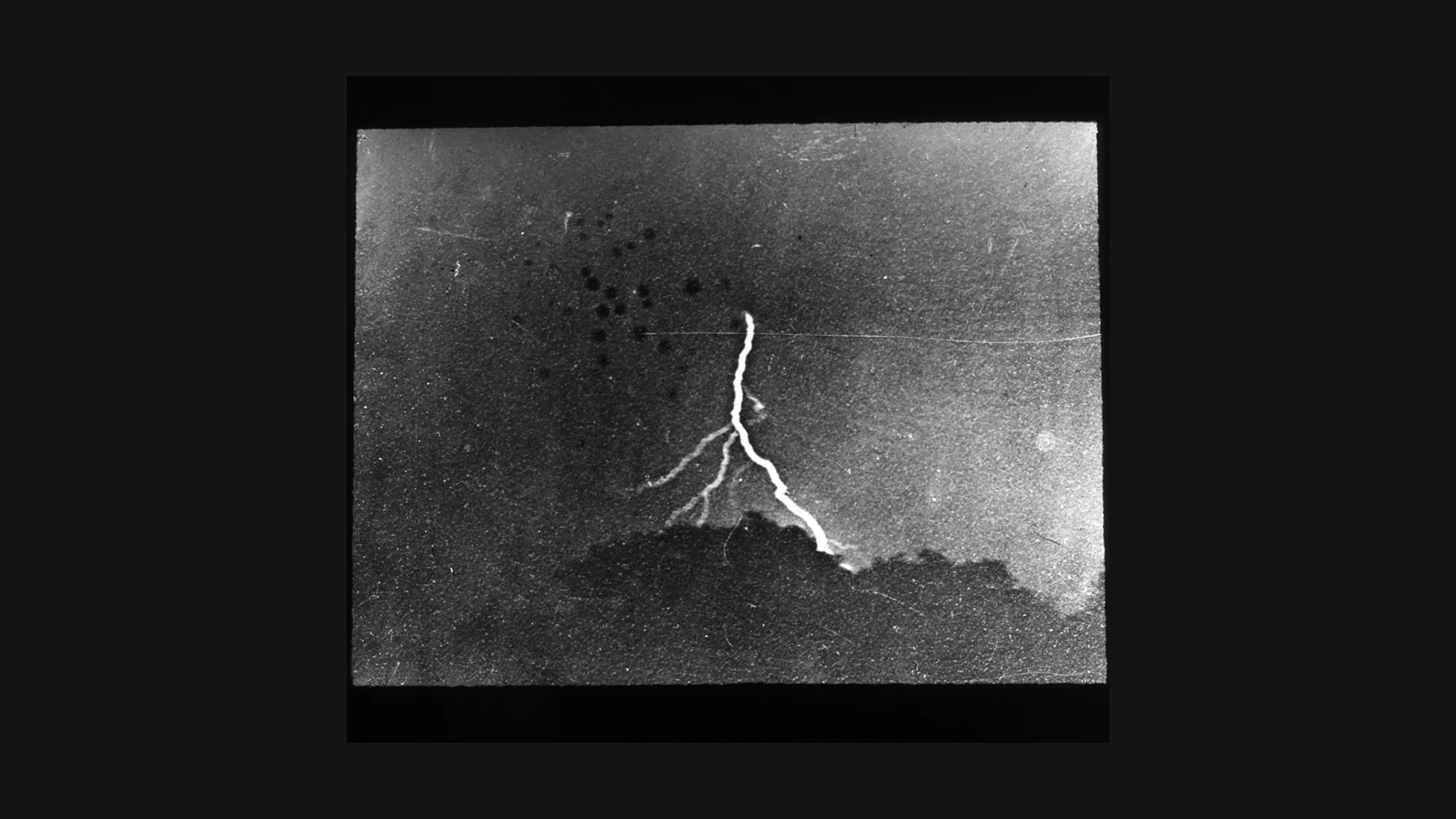
William Jennings' lightning photos, catalyzed both scientific insight and photographic innovation.
In the late 19th century, William N. Jennings charted new territory by capturing lightning, an achievement that previously seemed unattainable due to the era's slow exposure times. These pioneering images not only served as a technical breakthrough but also provided a visual spectacle of lightning’s intricate structures.
Jennings' success laid the groundwork for high-speed photography, facilitating later advancements that could capture even faster phenomena like bullets in flight and splashing droplets. His work unveiled the hidden complexities of lightning, its branching paths and the dynamic interactions within a storm. This not only advanced scientific understanding of atmospheric electricity but also captivated the public and artists alike, merging aesthetic allure with empirical research.
Jennings’ photographs became a crucial junction in the history of photography, expanding its role from mere documentation to a vital instrument in both artistic and scientific explorations.
FROM THE COLLECTION
A close reading of the technique, the context, and what this image establishes as a Point Zero. Read the essay
KEY REFERENCE POINTS
TECHNICAL: Glass plate gelatin transparency・silver gelatin print・1024×853px original・2 September 1882・Philadelphia・long exposure ambient capture・branching channel detail
INFLUENCE: First photograph of lightning・precursor to high-speed photography・enabled study of atmospheric electricity・held at George Eastman Museum & The Franklin Institute
ANALYTICAL: Reveals lightning's branching structure・documents electrical discharge paths・demonstrated photography as scientific instrument・expanded exposure technique understanding
CULTURAL IMPACT: Public fascination with natural phenomena・merged empirical research with aesthetic spectacle・redefined photography's role beyond documentation
ARCHIVAL RECORD
CREDIT: William Nicholson Jennings, Public domain, via Wikimedia Commons
AUTHOR: William N. Jennings
TITLE: Unknown
DATE: 2 September 1882
ARCHIVE: George Eastman Museum
SOURCE: Wikimedia Commons
ORIGINAL: transparency, gelatin on glass
FILE: 1024 × 853 pixels, file size: 213 KB, MIME type: image/jpeg
AVAILABLE INFORMATION: First Photograph of Lightning, taken 2 September 1882, Philadelphia. Silver gelatin print. The Franklin Institute, Philadelphia.
EXTENDED CONTEXT
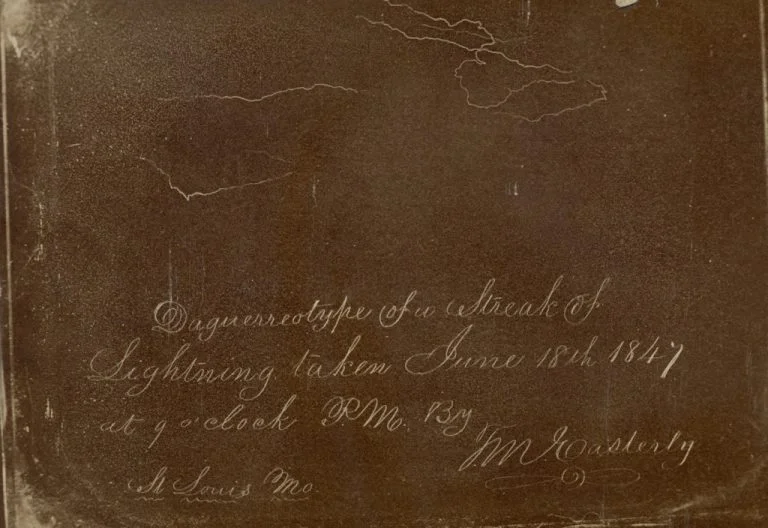
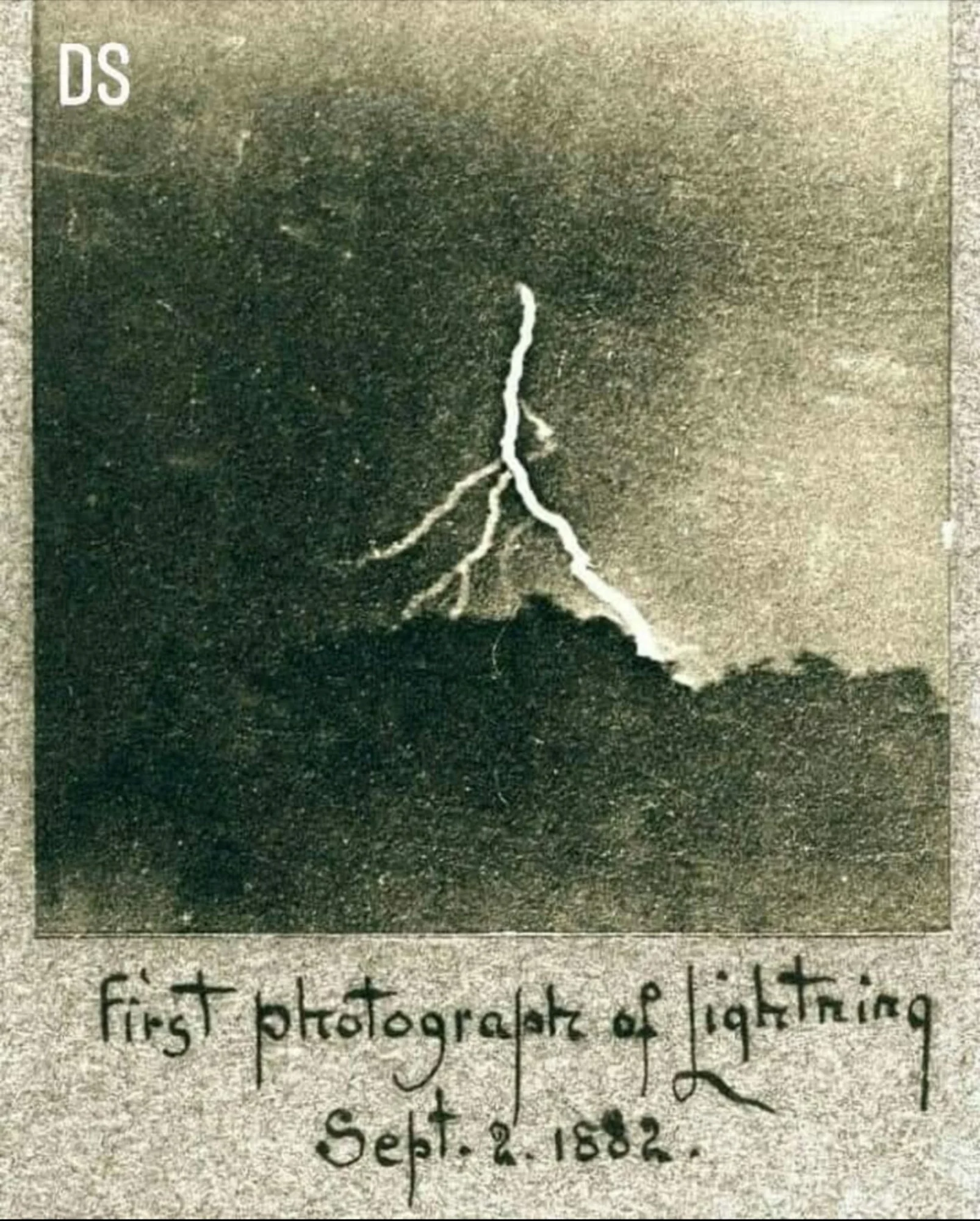
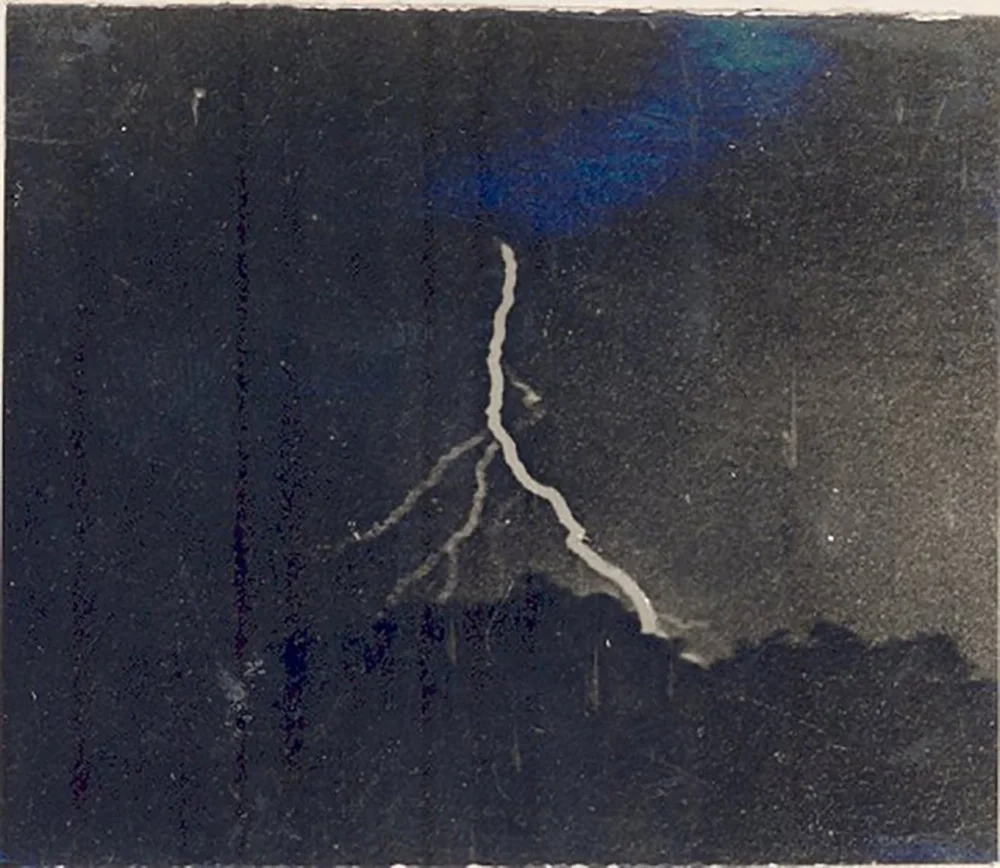
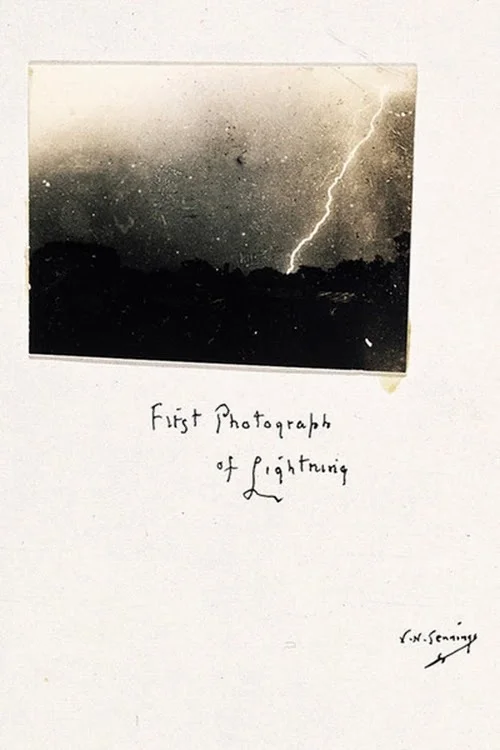
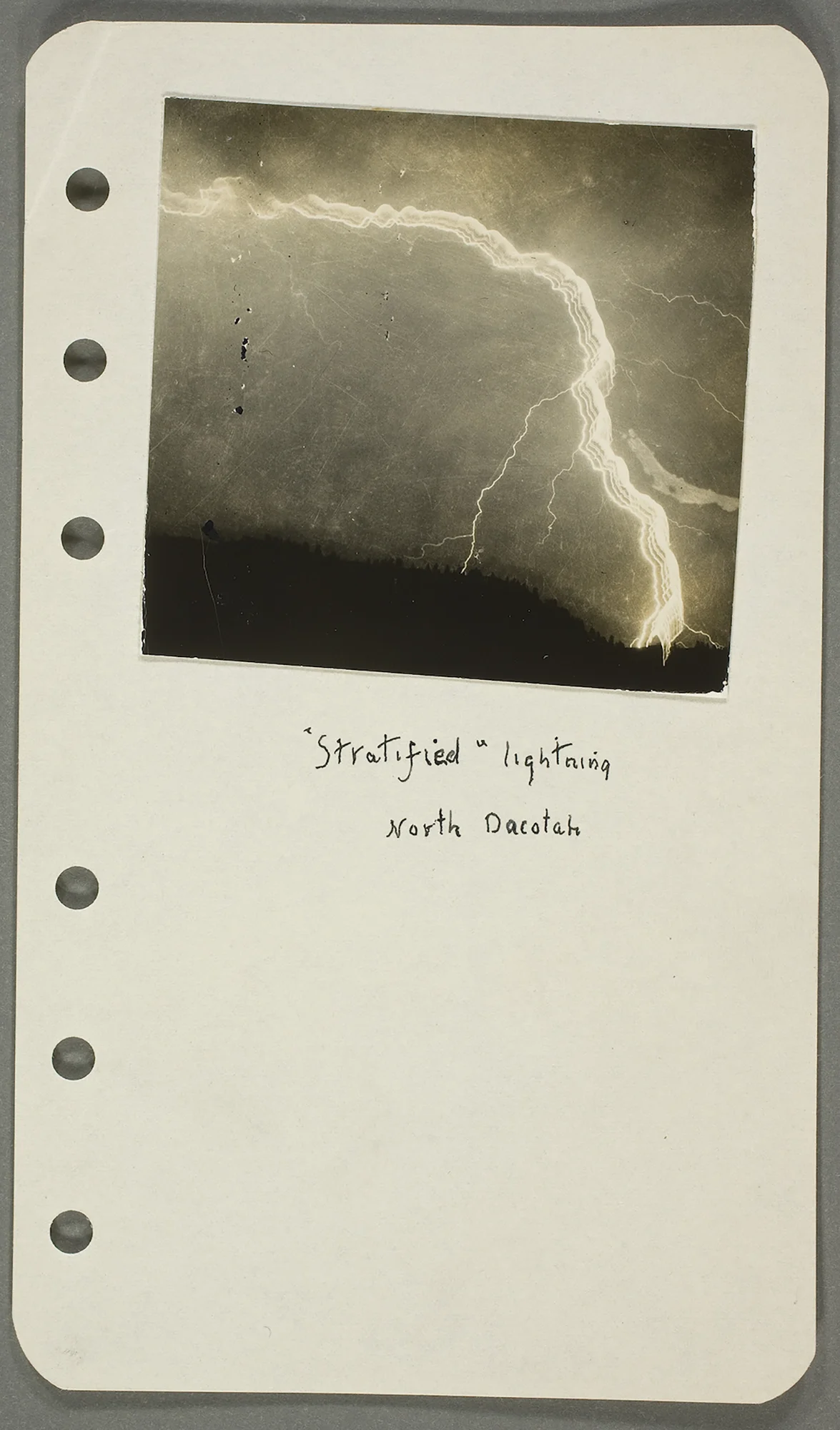
Image Credits (Left to Right):
Daguerreotype (1847, St. Louis) Credit image 1: Missouri Historical Society, No restrictions, via Wikimedia Commons, copy photograph of a lost Thomas Easterly daguerreotype that captured a streak of lightning on June 18th, 1847. From Missouri Historical Society, St. Louis.
Reproduction of First Photograph of Lightning (DS digital scan) Credit image 2: Reproduction of First Photograph of Lightning, William Nicholson Jennings (1860–1946), original negative dated 2 September 1882, Philadelphia; gelatin dry plate process; cropped reproduction bearing handwritten-style caption identifying the date and claiming primacy; tonal variation likely due to aged print or digitisation; reproduction from unidentified digital source (DS watermark present); original photograph public domain; reproduction rights undetermined; caption authenticity unverified.
Digitised Reproduction (slight colour cast) Credit image 3: Digitised reproduction of First Photograph of Lightning, William Nicholson Jennings (1860–1946), original negative dated 2 September 1882, Philadelphia; gelatin dry plate process; later scanned print with visible colour cast likely resulting from aged paper or digitisation; underlying image structure consistent with the 1882 negative; reproduction from unidentified source; original photograph public domain; reproduction rights undetermined.
Archival Album Page & Archival Binder Page (Later Lightning Exposure) Credit image 4&5: Archival album and folio reproductions of lightning photographs, William Nicholson Jennings (1860–1946), Philadelphia, late 19th century; gelatin dry plate process; examples from Jennings’ long-term photographic investigation of electrical discharge, during which he produced approximately 400 lightning exposures; printed reproductions mounted on album and binder pages, some bearing handwritten-style captions; reproduction from unidentified publication or archive; original photographs public domain; caption authenticity unverified.
Exploring the Influence of Proving an Assumption across Zero Baseline
Photography has often been used to settle questions that could not be resolved by assumption alone. Its impact comes from our inherent need to see in order to believe—turning speculation into something tangible and undeniable. These proofs revealed unseen mechanics of motion, verified natural patterns, and confirmed theoretical predictions. Advances in optics, timing, and image clarity increased the reliability of such evidence, ensuring that outcomes were no longer left to interpretation.
1878 EADWEARD MUYBRIDGE – THE HORSE IN MOTION
Sequential photographs proved that all four of a horse’s hooves leave the ground during a gallop, overturning a long-held visual assumption.
1882 WILLIAM JENNINGS – LIGHTNING
Photographs revealed that lightning follows jagged, branching paths rather than straight lines, visually disproving a centuries-old belief.
1882 ÉTIENNE-JULES MAREY – BIRDS
Chronophotographs demonstrated that birds’ wings trace complex elliptical paths in flight, offering unprecedented insight into biomechanics.
1888 ISAAC ROBERTS – NEBULA IN THE PLEIADES
Captured faint nebulosity around the Pleiades, confirming that interstellar dust reflects starlight as long suggested by theory.
1890 WILSON A. BENTLEY – PHOTOMICROGRAPH OF STELLAR SNOWFLAKE NO. 10
Photomicrograph confirmed that each snowflake has a unique crystalline structure, offering visual proof for theories of atmospheric formation.
1900 A.M. WORTHINGTON - SPLASH
Spark photographs revealed that a liquid impact forms a crown and rising column, proving that fluid motion follows consistent physical patterns.
Exploring the Influence of High-Speed Capture across Zero Baseline
High-speed capture has always been a pursuit against the limits of time itself. From early shadowgraphy and electrical discharge experiments to stroboscopic precision, ultra-fast sensors, and contemporary re-imaginings of energy and motion, each advance has sought to close the distance between event and image. These breakthroughs transformed photography into a medium capable of revealing what lies beyond human perception — freezing the fleeting, visualising shockwaves, or tracing light in motion. Whether achieved through the camera, the sensor, or direct physical interaction, high-speed imaging continues to expand our capacity to observe, measure, and imagine the dynamics of an unseen world.
1882 WILLIAM JENNINGS – LIGHTNING
Pioneered high-speed capture of lightning, overcoming long-exposure limitations.
1887 ERNST MACH – BRASS BULLET
Photographed a supersonic bullet in flight, revealing shock waves and confirming theoretical models of high-speed motion.
1900 A.M. WORTHINGTON - SPLASH
Used spark photography to freeze liquid motion in unprecedented detail.
1964 HAROLD EUGENE EDGERTON – BULLET THROUGH APPLE
Perfected stroboscopic precision to capture microsecond phases of motion.
2009 HIROSHI SUGIMOTO – LIGHTNING FIELDS 225
Used a 400,000-volt generator to record electrical discharges directly on film, transforming raw energy as the photographic image.
2012 RAMESH RASKAR, MIT - TRILLION FRAMES PER SECOND
Recorded light in motion at a trillion frames per second (Femto-Photography).
2014 PCHARITO, CERN - ALICELEAD3
Using sensors capable of nanosecond-scale imaging, this high-speed image captures traces of tiny particles colliding at near light speed.