2009
Lightning Fields 225
Hiroshi Sugimoto
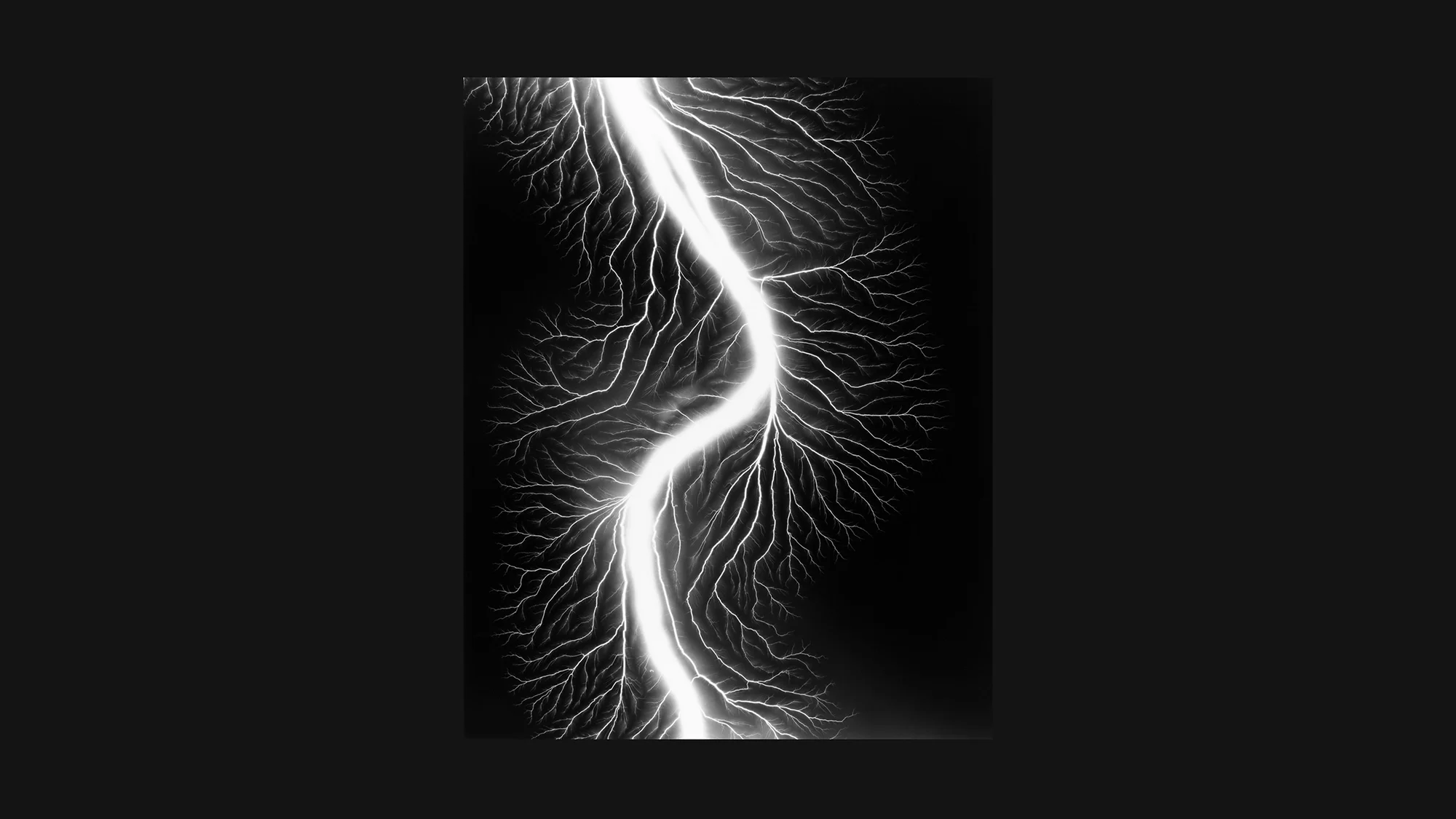
Sugimoto directly recorded high-voltage discharges, revealing the trace of raw electrical energy on a non-conductive surface.
In Lightning Fields 225 (2009), Hiroshi Sugimoto removed the camera entirely, allowing electricity itself to create the image. Using a large-format sheet of photographic film, he channelled 400’000 volts of electrical discharge across the surface to expose the image. The resulting photograph is a complex web of branching filaments, a literal trace of energy.
This process transforms photography into a natural event: electricity shaping its own luminous geometry. At once an act of scientific experimentation and artistic creation, Lightning Fields visualises energy in its raw state, a precise recording of a physical phenomenon and a meditation on the beauty of its form. Here, the photographic medium becomes both subject and tool, redefining exposure as an elemental interaction. The image is not captured but generated, an imprint of pure energy made visible through light.
KEY REFERENCE POINTS
TECHNICAL: Gelatin silver print・400,000-volt discharge onto large-format film・camera-free exposure・Lichtenberg figure formation・electrical energy as direct imaging agent
INFLUENCE: Extends photogram tradition (Man Ray, Moholy-Nagy)・radicalises cameraless photography・reframes exposure as physical event・part of ongoing Lightning Fields series (1968–present)
ANALYTICAL: Image as physical trace, not optical capture・electricity self-recording its own geometry・process collapses tool and subject・scientific phenomenon as primary visual data
CULTURAL IMPACT: Photography redefined as elemental act・bridges scientific imaging and fine art・challenges authorship (artist as conductor, not photographer)・© Hiroshi Sugimoto, courtesy Fraenkel Gallery & Lisson Gallery
ARCHIVAL RECORD
CREDIT: © Hiroshi Sugimoto, courtesy Fraenkel Gallery, San Francisco and Lisson Gallery
AUTHOR: Hiroshi Sugimoto
TITLE: Lightning Fields 225
DATE: 2009
ARCHIVE: no archival credit required, per correspondence
SOURCE: Courtesy of the artist, Fraenkel Gallery, San Francisco and Lisson Gallery
ORIGINAL: Gelatin silver print, size variable
AVAILABLE INFORMATION: Part of Hiroshi Sugimoto’s Lightning Fields series, created by discharging high-voltage electricity directly onto photographic film. The process records the physical trace of electrical energy without the use of a camera, producing intricate, branching patterns of light that reveal the natural geometry of electrical phenomena.
EXTENDED CONTEXT
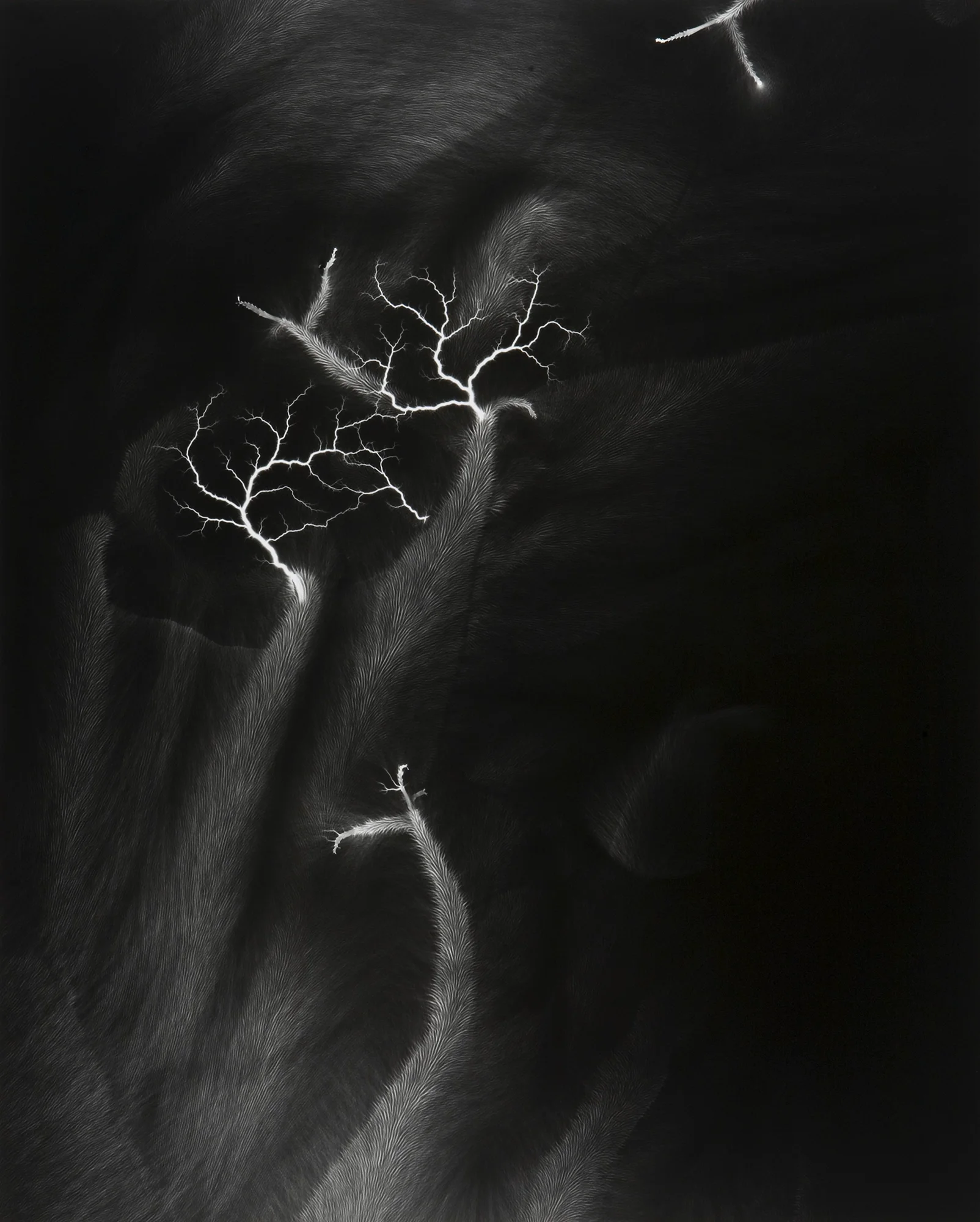
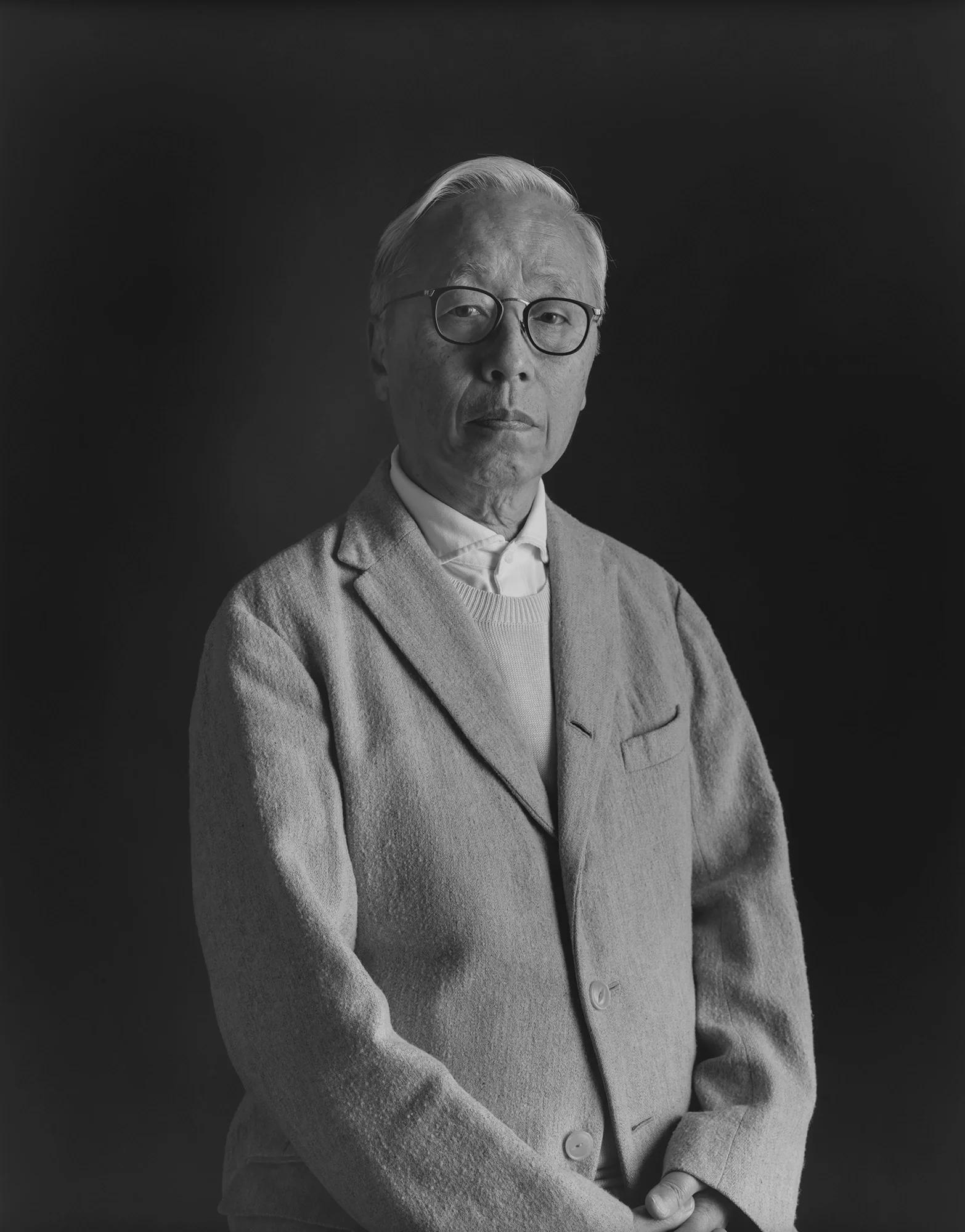
Additional image credits (left to right): Image 1: Hiroshi Sugimoto, Lightning Fields 119, 2009. Gelatin silver print. © Hiroshi Sugimoto, courtesy Fraenkel Gallery, San Francisco and Lisson Gallery. Image 2: Hiroshi Sugimoto, Self-Portrait, 2019. Gelatin silver print. © Hiroshi Sugimoto, courtesy Fraenkel Gallery, San Francisco and Lisson Gallery.
Exploring the Influence of High-Speed Capture across Zero Baseline
High-speed capture has always been a pursuit against the limits of time itself. From early shadowgraphy and electrical discharge experiments to stroboscopic precision, ultra-fast sensors, and contemporary re-imaginings of energy and motion, each advance has sought to close the distance between event and image. These breakthroughs transformed photography into a medium capable of revealing what lies beyond human perception — freezing the fleeting, visualising shockwaves, or tracing light in motion. Whether achieved through the camera, the sensor, or direct physical interaction, high-speed imaging continues to expand our capacity to observe, measure, and imagine the dynamics of an unseen world.
1882 WILLIAM JENNINGS – LIGHTNING
Pioneered high-speed capture of lightning, overcoming long-exposure limitations.
1887 ERNST MACH – BRASS BULLET
Photographed a supersonic bullet in flight, revealing shock waves and confirming theoretical models of high-speed motion.
1900 A.M. WORTHINGTON - SPLASH
Used spark photography to freeze liquid motion in unprecedented detail.
1964 HAROLD EUGENE EDGERTON – BULLET THROUGH APPLE
Perfected stroboscopic precision to capture microsecond phases of motion.
2009 HIROSHI SUGIMOTO – LIGHTNING FIELDS 225
Used a 400,000-volt generator to record electrical discharges directly on film, transforming raw energy as the photographic image.
2012 RAMESH RASKAR, MIT - TRILLION FRAMES PER SECOND
Recorded light in motion at a trillion frames per second (Femto-Photography).
2014 PCHARITO, CERN - ALICELEAD3
Using sensors capable of nanosecond-scale imaging, this high-speed image captures traces of tiny particles colliding at near light speed.