1878
The Horse in Motion
Eadweard Muybridge
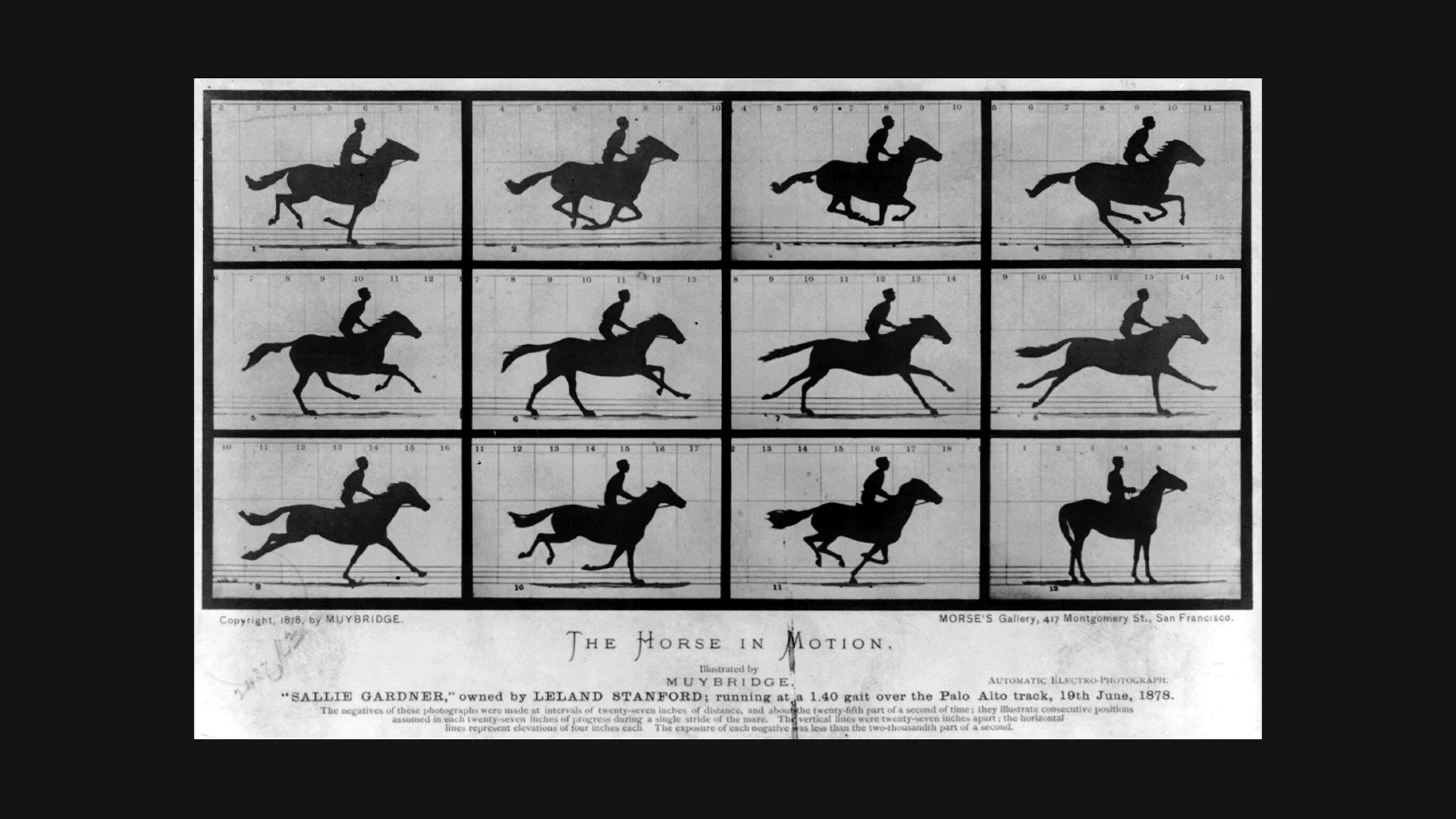
“The Horse in Motion” visually dissected a gallop, pioneering motion capture and influencing future camera technologies.
Eadweard Muybridge's 1878 sequence 'The Horse in Motion' introduced motion capture, setting a precedent in both art and science. This series captured a galloping horse with such clarity that it resolved a longstanding debate by showing all four of the horse's hooves off the ground simultaneously.
Employing a revolutionary technique, Muybridge set up 12 cameras along a track, each triggered by a trip wire activated by the horse’s own motion. This setup utilised the rapid, yet precise wet plate collodion process. The crisp detail and sequential exposure of Muybridge's photographs offered a new visual understanding of dynamic movement, previously a blur to the human eye.
This breakthrough not only expanded the capabilities of photographic technology but also laid foundational techniques that spurred the development of faster shutter systems and the motion picture camera. Moreover, "The Horse in Motion" had profound implications for both scientific research and the arts, providing a tool for the detailed study of biomechanics and animal locomotion.
From the caption area of the image:
Left: Copyright, 1878, by MUYBRIDGE. Right: MORSE'S Gallery, 417 Montgomery Street, San Francisco.
THE HORSE IN MOTION. Illustrated by MUYBRIDGE. AUTOMATIC ELECTRO-PHOTOGRAPH.
"SALLIE GARDNER," owned by LELAND STANFORD; running at a 1.40 gait over the Palo Alto track, 19th June, 1878.
The negatives of these photographs were made at intervals of twenty-seven inches of distance, and about the twenty-fifth part of a second of time; they illustrate consecutive positions assumed in each twenty-seven inches of progress during a single stride of the mare. The vertical lines were twenty-seven inches apart; the horizontal lines represent elevations of four inches each. The exposure of each negative was less than the two-thousandth part of a second.
KEY REFERENCE POINTS
TECHNICAL: 12-camera track setup・trip-wire shutter trigger・wet plate collodion process・albumen print on card・sequential multi-frame exposure・b&w film copy negative
INFLUENCE: First photographic proof of unsupported transit・resolved hooves-airborne debate・precursor to motion picture camera・advanced fast shutter development・Library of Congress archive
ANALYTICAL: Decomposed continuous motion into discrete frames・revealed movement invisible to the human eye・established sequential photography as scientific method・biomechanics and animal locomotion research tool
CULTURAL IMPACT: Redefined relationship between photography and time・bridged science and visual art・foundational reference in cinema history・reshaped how motion is depicted in art and illustration
ARCHIVAL RECORD
CREDIT: Muybridge, Eadweard (1878)
AUTHOR: Muybridge, Eadweard
TITLE: The Horse in Motion
DATE: 19 June 1878
ARCHIVE: Library of Congress Prints and Photographs Division
SOURCE: Library of Congress, No known restrictions on publication
ORIGINAL: Reproduction, digital file from original item, b&w film copy neg.
AVAILABLE INFORMATION: 1 photographic print on card: albumen. Photograph with twelve frames showing motion of a race horse.
Exploring the Influence of Proving an Assumption across Zero Baseline
Photography has often been used to settle questions that could not be resolved by assumption alone. Its impact comes from our inherent need to see in order to believe—turning speculation into something tangible and undeniable. These proofs revealed unseen mechanics of motion, verified natural patterns, and confirmed theoretical predictions. Advances in optics, timing, and image clarity increased the reliability of such evidence, ensuring that outcomes were no longer left to interpretation.
1878 EADWEARD MUYBRIDGE – THE HORSE IN MOTION
Sequential photographs proved that all four of a horse’s hooves leave the ground during a gallop, overturning a long-held visual assumption.
1882 WILLIAM JENNINGS – LIGHTNING
Photographs revealed that lightning follows jagged, branching paths rather than straight lines, visually disproving a centuries-old belief.
1882 ÉTIENNE-JULES MAREY – BIRDS
Chronophotographs demonstrated that birds’ wings trace complex elliptical paths in flight, offering unprecedented insight into biomechanics.
1888 ISAAC ROBERTS – NEBULA IN THE PLEIADES
Captured faint nebulosity around the Pleiades, confirming that interstellar dust reflects starlight as long suggested by theory.
1890 WILSON A. BENTLEY – PHOTOMICROGRAPH OF STELLAR SNOWFLAKE NO. 10
Photomicrograph confirmed that each snowflake has a unique crystalline structure, offering visual proof for theories of atmospheric formation.
1900 A.M. WORTHINGTON - SPLASH
Spark photographs revealed that a liquid impact forms a crown and rising column, proving that fluid motion follows consistent physical patterns.
Exploring the Influence of Motion Study across Zero Baseline
Motion study investigates the structure of movement — how motion unfolds, can be measured, and understood through photography. From early chronophotography to contemporary scientific visualisation, these works transform movement into a series of knowable forms. By segmenting motion into observable patterns, photography becomes a tool for analysing the mechanics of the visible world. Each image extends perception, revealing how things move, behave, and interact through time.
1878 EADWEARD MUYBRIDGE – THE HORSE IN MOTION
Muybridge used sequential photography to dissect the gallop into still frames, revealing movement too fast for the eye and transforming how motion could be studied and understood.
1882 ÉTIENNE-JULES MAREY – BIRDS
Using chronophotography, Marey broke down continuous flight into discrete, analysable frames—laying the foundation for modern studies of motion and biomechanics.
1887 EADWEARD MUYBRIDGE – ANIMAL LOCOMOTION. PLATE 762
Sequential frames capturing the phases of a bird in flight, offering one of the earliest detailed visual studies of avian motion (bird motion).
1900 A.M. WORTHINGTON - SPLASH
Used spark photography to reveal the fluid structures formed in the instant of liquid impact.
1900 ÉTIENNE-JULES MAREY – AIR MOVEMENT IN A COLLISION WITH OBJECTS OF DIFFERENT SHAPES
Captured the flow of air as a continuous pattern, revealing the invisible movement shaped by varying forms and atmospheric resistance.
1973 BUBBLE CHAMBER-CERN-EX-23296
Captured the spiralling paths of subatomic particles through liquid, revealing motion patterns that defined their charge, momentum, and interactions.
2015 LIGHT AS WAVE AND PARTICLE
Captured light behaving simultaneously as both wave and particle, providing direct visual evidence of quantum duality.
2020 REGINA VALKENBORGH - PERPETUITY LONGEST EXPOSURE
An eight-year exposure revealing the sun's daily path, etched across the sky in 2,953 luminous arcs.