1964
Bullet through Apple
Harold Eugene Edgerton
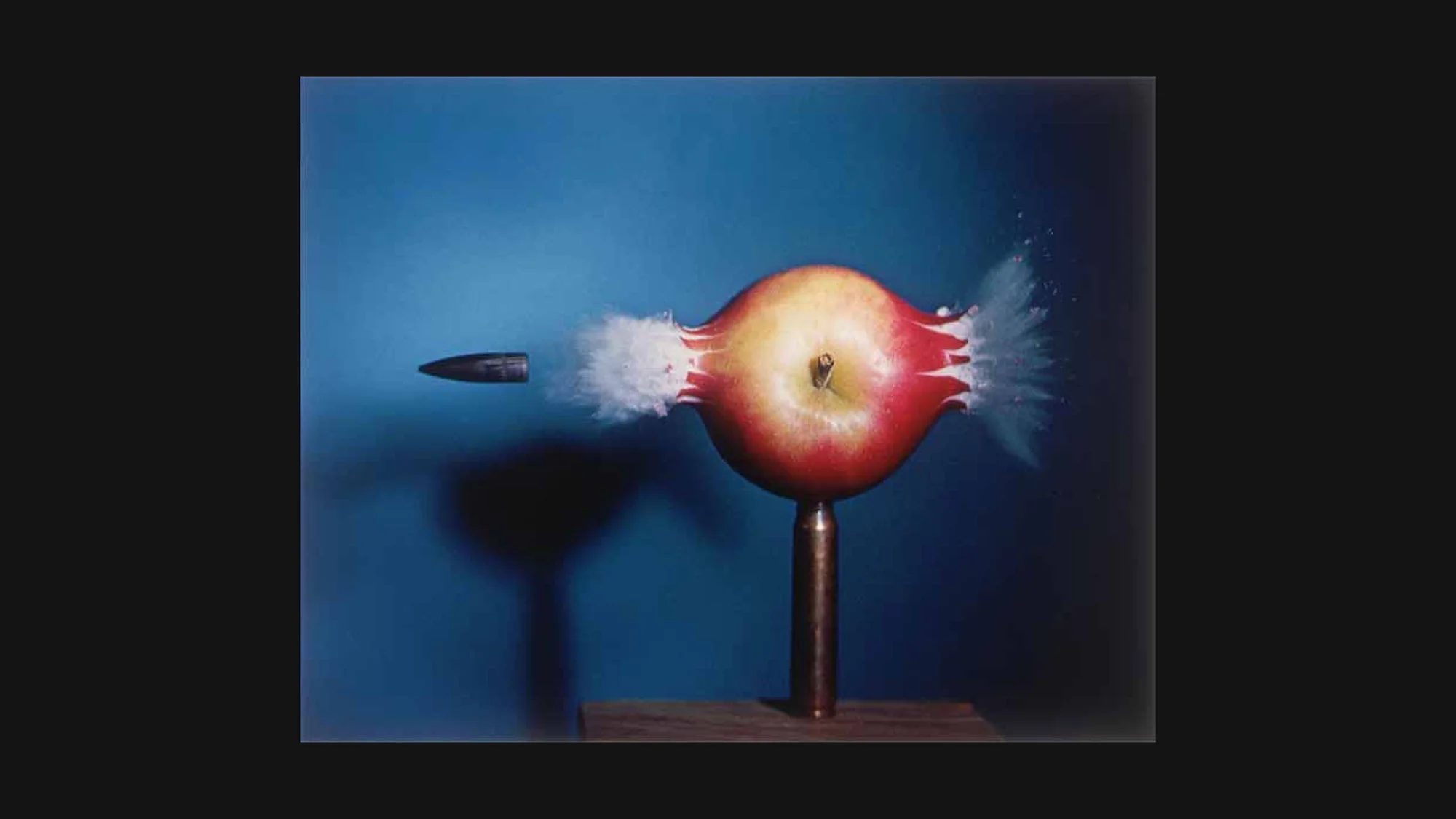
Harold Edgerton's contribution to High-Speed Photography.
The development of high-speed photography by Harold Edgerton, marks a transformative era in the history of photography, with ground-breaking visual insights. Edgerton’s iconic image of a bullet piercing an apple exemplifies this, capturing a fleeting moment at speeds unimaginable before. This photograph not only demonstrated the ability to freeze time but also revealed hidden aspects of physical dynamics, offering a new perspective on High-Speed Photography.
Edgerton synchronised strobe flashes at intervals precise enough to illuminate and capture successive phases of rapid motion, with stroboscopic photography. His invention of the electronic flash, capable of lighting for a millionth of a second, allowed him to photograph objects moving at extreme velocities, a technique previously considered unfeasible.
These innovations propelled technological advancements in various scientific fields, enabling researchers to visualise and refine theories about fast-moving phenomena. Edgerton’s approach transformed photographic practice, influencing both contemporary art and scientific investigation by making complex concepts visually compelling and accessible.
KEY REFERENCE POINTS
TECHNICAL: Electronic strobe flash・1/1,000,000 sec exposure・stroboscopic synchronisation・729×567px original・MIT archive・1.8MB source file
INFLUENCE: Pioneered high-speed photography・electronic flash invention・enabled scientific motion visualisation・foundational MIT research・influenced lab and studio practice globally
ANALYTICAL: Reveals ballistic physics invisible to the eye・demonstrates freeze-frame stroboscopy・motion dynamics made measurable・bridges scientific method and photographic image
CULTURAL IMPACT: Iconic image of time stopped・photography as scientific instrument・influence on art・redefined what a camera could show
ARCHIVAL RECORD
CREDIT: Edgerton, H. (1964), © 2010 MIT. Courtesy of MIT Museum
AUTHOR: Harold Edgerton (1964)
TITLE: Bullet through apple
DATE: 1964
ARCHIVE: MIT Museum
SOURCE: The Edgerton Digital Collections project, HEE-NC-64002
ORIGINAL: 729 x 567 pixels, file size: 1.8 MB
AVAILABLE INFORMATION: High Speed Photography
Exploring the Influence of High-Speed Capture across Zero Baseline
High-speed capture has always been a pursuit against the limits of time itself. From early shadowgraphy and electrical discharge experiments to stroboscopic precision, ultra-fast sensors, and contemporary re-imaginings of energy and motion, each advance has sought to close the distance between event and image. These breakthroughs transformed photography into a medium capable of revealing what lies beyond human perception — freezing the fleeting, visualising shockwaves, or tracing light in motion. Whether achieved through the camera, the sensor, or direct physical interaction, high-speed imaging continues to expand our capacity to observe, measure, and imagine the dynamics of an unseen world.
1882 WILLIAM JENNINGS – LIGHTNING
Pioneered high-speed capture of lightning, overcoming long-exposure limitations.
1887 ERNST MACH – BRASS BULLET
Photographed a supersonic bullet in flight, revealing shock waves and confirming theoretical models of high-speed motion.
1900 A.M. WORTHINGTON - SPLASH
Used spark photography to freeze liquid motion in unprecedented detail.
1964 HAROLD EUGENE EDGERTON – BULLET THROUGH APPLE
Perfected stroboscopic precision to capture microsecond phases of motion.
2009 HIROSHI SUGIMOTO – LIGHTNING FIELDS 225
Used a 400,000-volt generator to record electrical discharges directly on film, transforming raw energy as the photographic image.
2012 RAMESH RASKAR, MIT - TRILLION FRAMES PER SECOND
Recorded light in motion at a trillion frames per second (Femto-Photography).
2014 PCHARITO, CERN - ALICELEAD3
Using sensors capable of nanosecond-scale imaging, this high-speed image captures traces of tiny particles colliding at near light speed.