1888
Nebula in the Pleiades
Isaac Roberts
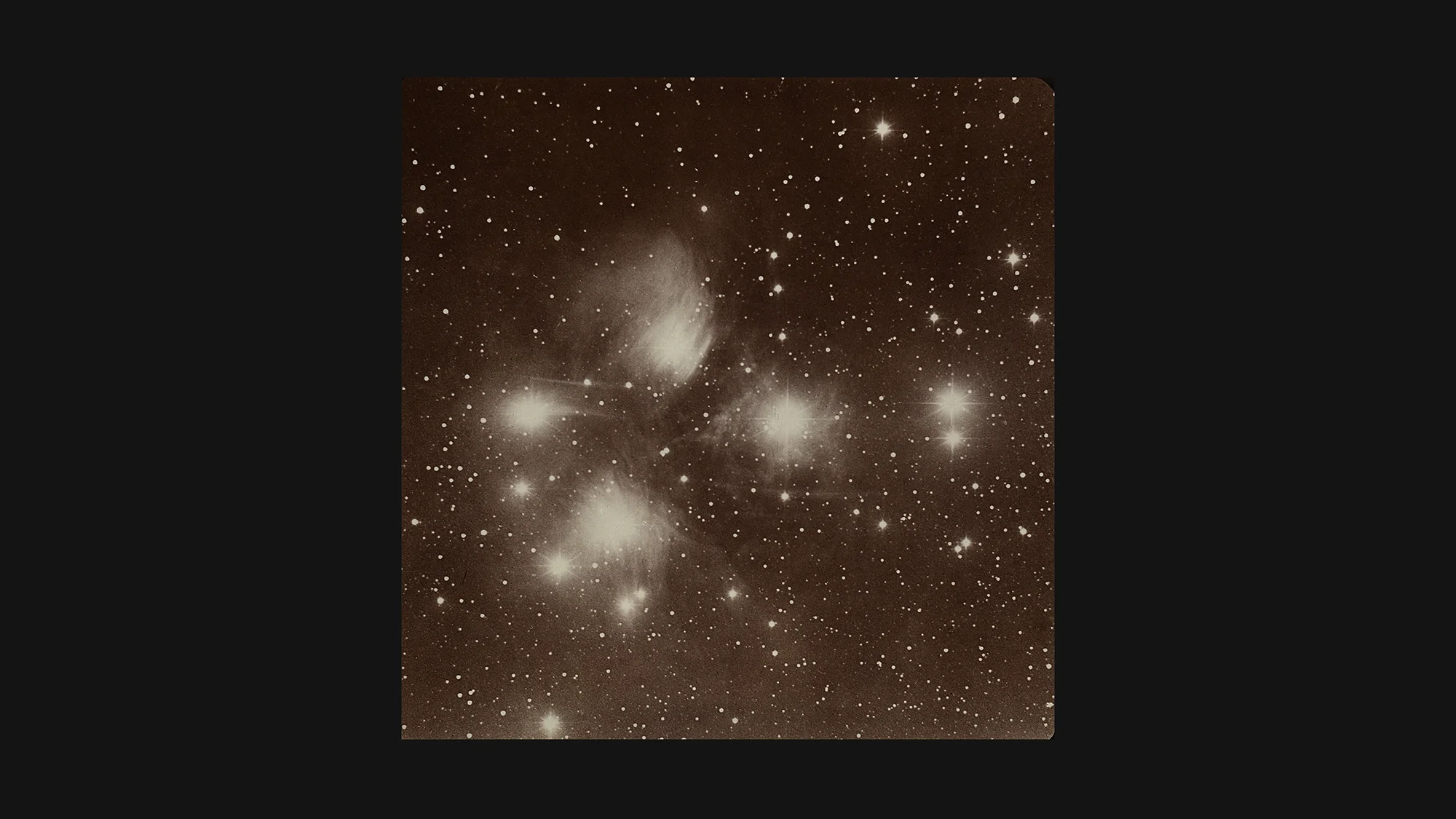
The First Successful Photograph of a Reflection Nebula – A New Way of Seeing the Stars
On 8 December 1888, Isaac Roberts captured a long-exposure photograph of the Nebula in the Pleiades using his 20-inch reflector telescope. Taken from his private observatory in Crowborough, Sussex, this image is one of the earliest known photographs to successfully reveal the faint nebulosity surrounding the Pleiades star cluster. It marked a new phase in astronomical imaging, showing that interstellar dust could reflect starlight—something previously suggested by theory but never directly recorded.
This breakthrough image demonstrated the potential of astrophotography to make visible what the eye alone could not perceive. Roberts’ careful alignment and prolonged exposure allowed diffuse structures to emerge on the photographic plate with unprecedented clarity. His work not only helped confirm the existence of reflection nebulae but also paved the way for photography to become central to astronomical discovery.
Preserved and digitised by ETH Bibliothek in Zürich, the Pleiades plate is a key example of how visual observation gave way to photographic evidence. With this image, Roberts redefined what it meant to "see" in astronomy—capturing the hidden architecture of starlight for the first time.
KEY REFERENCE POINTS
TECHNICAL: 20-inch reflector telescope・long-exposure wet plate photography・private observatory, Crowborough, Sussex・13×13 cm paper print on cardboard・ETH Bibliothek accession ETH Bibliothek_Ans_02775-126
INFLUENCE: First photograph of a reflection nebula・confirmed interstellar dust reflects starlight・established astrophotography as primary discovery method・digitised by ETH Bibliothek, Zürich
ANALYTICAL: Reveals diffuse nebulosity invisible to the naked eye・demonstrates photographic plate sensitivity exceeding human vision・evidence-based shift from observation to recording・key document in interstellar dust research
CULTURAL IMPACT: Redefined astronomical "seeing"・made the invisible visible・private observatory science contributing to institutional knowledge・emblematic of late-Victorian photographic revolution in science
ARCHIVAL RECORD
CREDIT: ETH Bibliothek, Zürich (E-Pics Bildarchiv Online), Accession No. ETH Bibliothek_Ans_02775-126
AUTHOR: Roberts, Dr. Isaac
TITLE: Nebula in the Pleiades
DATE: 8 December 1888
ARCHIVE: ETH Bibliothek E-Pics Bildarchiv
SOURCE: ETH Bibliothek, Zürich
ORIGINAL: Paper print mounted on cardboard; 13 × 13 cm
AVAILABLE INFORMATION: Photographed by Dr Isaac Roberts using a 20-inch reflector telescope, this long-exposure image captured the nebulosity around the Pleiades star cluster—revealing for the first time the reflection of starlight off interstellar dust. Digitised and preserved by ETH Bibliothek, the plate exemplifies Roberts’ pioneering role in astrophotography and the emergence of photographic methods as tools of astronomical discovery.
EXTENDED CONTEXT
The First Photograph to Reveal the Spiral Form of a Galaxy
On 29 December 1888, just 21 days after photographing the Pleiades, Isaac Roberts captured a long-exposure image of the Andromeda Nebula (M31). This was the first photograph to reveal a spiral structure in a nebula—a striking and unprecedented form that would reshape the understanding of the cosmos.
At the time, the nature of spiral nebulae was still debated. Roberts’ image offered compelling visual evidence that these objects might be vast systems of stars, separate from the Milky Way. Though the true nature of galaxies would not be confirmed until decades later, this photograph helped shift astronomy from speculation to observable structure—expanding both the reach and ambition of astrophotography.
Image Credit: ETH Library Zurich, Image Archive / Ans_02775-132, Author: Roberts, Isaac, Title: Nebula in Andromeda, Date: 29.12.1888
Exploring the Influence of Proving an Assumption across Zero Baseline
Photography has often been used to settle questions that could not be resolved by assumption alone. Its impact comes from our inherent need to see in order to believe—turning speculation into something tangible and undeniable. These proofs revealed unseen mechanics of motion, verified natural patterns, and confirmed theoretical predictions. Advances in optics, timing, and image clarity increased the reliability of such evidence, ensuring that outcomes were no longer left to interpretation.
1878 EADWEARD MUYBRIDGE – THE HORSE IN MOTION
Sequential photographs proved that all four of a horse’s hooves leave the ground during a gallop, overturning a long-held visual assumption.
1882 WILLIAM JENNINGS – LIGHTNING
Photographs revealed that lightning follows jagged, branching paths rather than straight lines, visually disproving a centuries-old belief.
1882 ÉTIENNE-JULES MAREY – BIRDS
Chronophotographs demonstrated that birds’ wings trace complex elliptical paths in flight, offering unprecedented insight into biomechanics.
1888 ISAAC ROBERTS – NEBULA IN THE PLEIADES
Captured faint nebulosity around the Pleiades, confirming that interstellar dust reflects starlight as long suggested by theory.
1890 WILSON A. BENTLEY – PHOTOMICROGRAPH OF STELLAR SNOWFLAKE NO. 10
Photomicrograph confirmed that each snowflake has a unique crystalline structure, offering visual proof for theories of atmospheric formation.
1900 A.M. WORTHINGTON - SPLASH
Spark photographs revealed that a liquid impact forms a crown and rising column, proving that fluid motion follows consistent physical patterns.