1900
Air movement in a collision with objects of different shapes
Étienne-Jules Marey
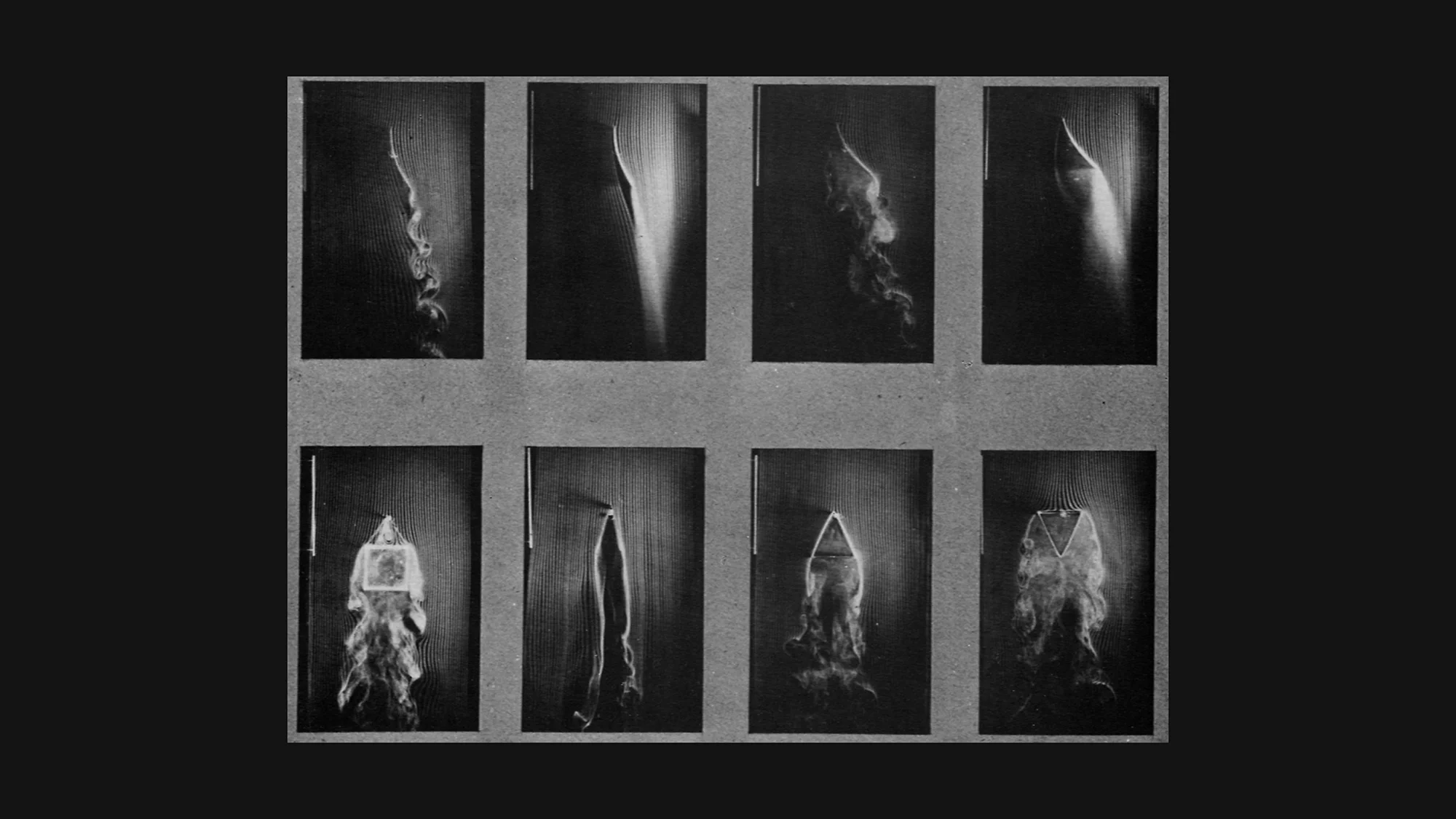
Marey's techniques visualised air movement, enhancing both scientific analysis and artistic expression across disciplines.
Through his pioneering images of air movement, Étienne-Jules Marey captured more than just motion, he visualised the invisible. By using a smoke machine, Marey transformed photography into a tool capable of revealing invisible air patterns, such as turbulence and flow dynamics, with unprecedented clarity.
This visual revelation was made possible through chronophotography, a technique Marey pioneered. It involved capturing multiple stages of motion in a single image, using either multiple cameras or one camera with several lenses. This method not only illustrated the fluidity of air around objects but also combined scientific precision with photographic artistry, allowing for detailed analysis of phenomena too rapid for the naked eye.
Marey’s approach revolutionised photographic technology and methodology, influencing subsequent advancements in measurement techniques across various fields, including biomechanics and fluid dynamics. His work bridged the gap between art and science, contributing aesthetically pleasing images that served scientific purposes and inspired movements in art. Marey’s legacy continues to resonate, underscoring the profound impact of his contributions on both artistic expression and scientific exploration.
KEY REFERENCE POINTS
TECHNICAL: Chronophotography・smoke machine visualisation・multiple exposure technique・2024×1535px JPEG・captures turbulence + flow dynamics invisible to naked eye
INFLUENCE: Pioneer of motion photography・foundational method for fluid dynamics imaging・influenced biomechanics research・precursor to modern flow visualisation techniques
ANALYTICAL: Reveals air behaviour around varying object shapes・turbulence vs. laminar flow patterns・photography as measurement instrument・methodology adopted across scientific disciplines
CULTURAL IMPACT: ridged art and science・aesthetic of invisible forces・influenced Futurism + abstract art movements・redefined photography as analytical tool beyond documentation
ARCHIVAL RECORD
CREDIT: Étienne-Jules Marey, Public domain, via Wikimedia Commons
AUTHOR: Étienne-Jules Marey (1900)
TITLE: Unknown
DATE: 1900 or 1901
ARCHIVE: Unknown
SOURCE: Wikimedia Commons
ORIGINAL: 2,024 x 1,535 pixels, file size: 307 KB, MIME type: image/jpeg
AVAILABLE INFORMATION: Air movement in a collision with objects of different shapes
EXTENDED CONTEXT
Image Credits: Unknown date, Unknown author, contributed by Eberhard J. Wormer at he.wikipedia, File: Étienne-Jules Marey.jpg, Public domain, via Wikimedia Commons.
Exploring the Influence of Motion Study across Zero Baseline
Motion study investigates the structure of movement — how motion unfolds, can be measured, and understood through photography. From early chronophotography to contemporary scientific visualisation, these works transform movement into a series of knowable forms. By segmenting motion into observable patterns, photography becomes a tool for analysing the mechanics of the visible world. Each image extends perception, revealing how things move, behave, and interact through time.
1878 EADWEARD MUYBRIDGE – THE HORSE IN MOTION
Muybridge used sequential photography to dissect the gallop into still frames, revealing movement too fast for the eye and transforming how motion could be studied and understood.
1882 ÉTIENNE-JULES MAREY – BIRDS
Using chronophotography, Marey broke down continuous flight into discrete, analysable frames—laying the foundation for modern studies of motion and biomechanics.
1887 EADWEARD MUYBRIDGE – ANIMAL LOCOMOTION. PLATE 762
Sequential frames capturing the phases of a bird in flight, offering one of the earliest detailed visual studies of avian motion (bird motion).
1900 A.M. WORTHINGTON - SPLASH
Used spark photography to reveal the fluid structures formed in the instant of liquid impact.
1900 ÉTIENNE-JULES MAREY – AIR MOVEMENT IN A COLLISION WITH OBJECTS OF DIFFERENT SHAPES
Captured the flow of air as a continuous pattern, revealing the invisible movement shaped by varying forms and atmospheric resistance.
1973 BUBBLE CHAMBER-CERN-EX-23296
Captured the spiralling paths of subatomic particles through liquid, revealing motion patterns that defined their charge, momentum, and interactions.
2015 LIGHT AS WAVE AND PARTICLE
Captured light behaving simultaneously as both wave and particle, providing direct visual evidence of quantum duality.
2020 REGINA VALKENBORGH - PERPETUITY LONGEST EXPOSURE
An eight-year exposure revealing the sun's daily path, etched across the sky in 2,953 luminous arcs.