1837
First Surviving Daguerreotype
Louis Daguerre
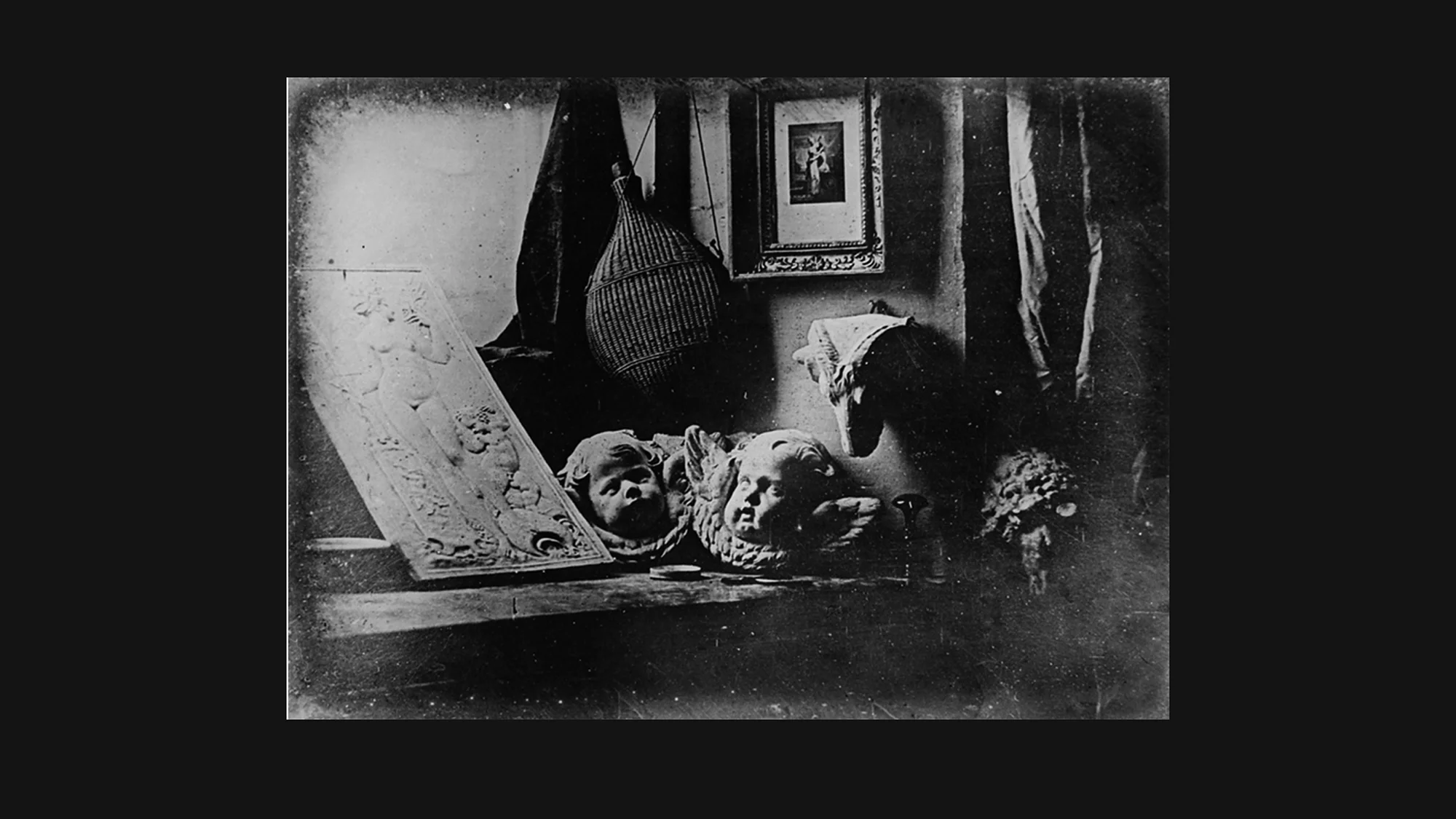
The first surviving proof that photography could capture and share the visible world with a fidelity beyond drawing.
In 1837, Louis-Jacques-Mandé Daguerre exposed a silver-plated copper plate for around eight hours, producing Still Life in Studio, the earliest known surviving daguerreotype. This carefully arranged composition of plaster casts, drawings, and a harp was not chosen for its subject matter but for its textures and tonal contrasts. The plate demonstrated the daguerreotype’s extraordinary capacity to record fine detail — surfaces, shadows, and light — with a precision that surpassed the hand of the draftsman.
What made this photograph revolutionary was not what it depicted, but how it depicted it. For the first time, reality could be transferred from a private studio into a fixed, shareable image, a visual proof that the world could be captured directly by light. Unlike William Henry Fox Talbot’s nearly contemporary paper negative (1835), which opened the way to reproducibility, Daguerre’s daguerreotype was a singular object: a one-off image of astonishing fidelity.
This survival marks the first point at which photography revealed its unique power, to produce an image that was not just a record but a presence, forever altering how reality could be seen, preserved, and shared.
KEY REFERENCE POINTS
TECHNICAL: Daguerreotype on silver-plated copper・mercury vapour development・salt fixation・~8-hour exposure・2,048 × 2,369 px original・1.3 MB JPEG (Wikimedia)・singular, non-reproducible image
INFLUENCE: Earliest surviving daguerreotype・predates Fox Talbot's paper negative (1835) in fidelity・announced publicly 1839・sparked global adoption within months・foundational to all subsequent photographic processes
ANALYTICAL: Subject chosen for tonal contrast and surface texture, not narrative・demonstrates silver plate's capacity to resolve fine detail・fixed light-based image vs. hand rendering・singular object vs. reproducible negative
CULTURAL IMPACT: First proof photography could transfer reality into a shareable fixed image・shifted visual authority from artist's hand to light itself・held at Société française de photographie, Paris・public domain via Wikimedia Commons
ARCHIVAL RECORD
CREDIT: Louis Daguerre, Public domain, via Wikimedia Commons
AUTHOR: Daguerre, Louis Jacques Mandé (1837)
TITLE: Still Life in Studio (L’Atelier de l’artiste)
DATE: 1837
ARCHIVE: Société française de photographie, Paris
SOURCE: Wikimedia Commons
ORIGINAL: 2,048 × 2,369 pixels, file size: 1.3 MB, JPEG
DESCRIPTION: The earliest known surviving daguerreotype, depicting a studio arrangement of plaster casts, drawings, and a harp.
AVAILABLE INFORMATION: Daguerreotype on silver-plated copper, developed with mercury vapour, fixed with salt.
EXTENDED CONTEXT
Boulevard du Temple by Louis Daguerre
In 1838, Daguerre aimed his camera at the busy Boulevard du Temple in Paris, requiring an exposure of around ten minutes. The moving crowds and carriages vanished, leaving the street eerily empty — except for one man, paused to have his boots shined. This chance detail, the first recorded human presence in a photograph, showed that photography could capture lived reality and reveal truths hidden in the flow of time.
Credit: Louis Daguerre, Public domain, via Wikimedia Commons, Author: Daguerre, L.-J.-M. (1838), Title: Boulevard du Temple, Date: 1838 (possibly late 1837), Archive: Wikimedia Commons / Public Domain, Source: Wikimedia Commons, Original file: Approx. 3,441 × 2,472 pixels; ~3.3 MB JPEG, Available information: The earliest surviving daguerreotype that includes a human figure—a man having his boots shined—captured in a long exposure on a busy Parisian street. Daguerreotype taken from the Diorama building; exposure of approximately 4–5 minutes; features a rarely preserved moment of everyday life frozen in time.
Exploring the Influence of Establishing Photography as a Medium across Zero Baseline
Photography’s earliest milestones established its very possibility as a medium. These foundational firsts secured permanence, enabled reproduction, expanded into scientific observation, and entered the circulation of published knowledge. In doing so, they demonstrated that photography could move beyond isolated experiments. Together, they defined the framework for the medium to grow and endure—forever changing what we are able to see, and how seeing it shapes our thinking.
1827 JOSEPH NICÉPHORE NIÉPCE – FIRST PERMANENT PHOTOGRAPH
Produced the first stable image on a pewter plate, proving that light-sensitive chemistry could fix a visual record permanently.
1835 WILLIAM HENRY FOX TALBOT – FIRST NEGATIVE
Created the earliest surviving paper negative, introducing a process that allowed multiple prints from a single image and establishing photography as a reproducible system.
1837 LOUIS DAGUERRE – FIRST SURVIVING DAGUERREOTYPE
Produced Still Life in Studio, a positive, unique image of remarkable clarity that proved photography could capture and share the visible world with a fidelity beyond drawing.
1840 JOHN DRAPER – EARLIEST IMAGE OF THE MOON
Captured the Moon with a daguerreotype, extending photography beyond Earth and positioning it as a tool for astronomical research and scientific discovery.
1843 ANNA ATKINS – FIRST BOOK OF PHOTOGRAMS
Published Photographs of British Algae: Cyanotype Impressions, the first book illustrated with photographic images, demonstrating photography’s capacity for cataloguing and knowledge dissemination.