1827
First Permanent Photograph
Joseph Nicéphore Niépce
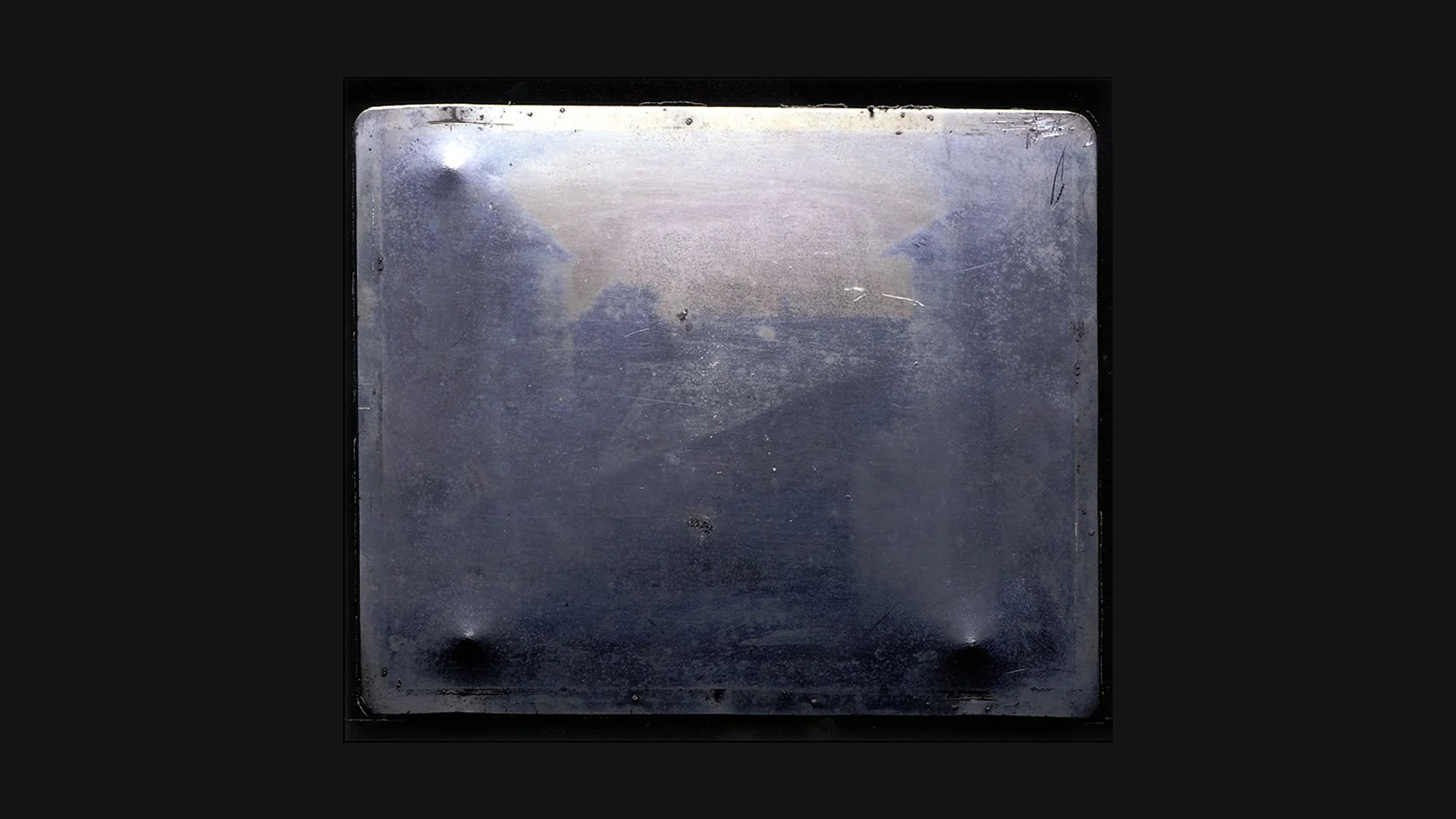
“View from the Window at Le Gras” by Joseph Niépce marked the birth of photography.
In 1827, Joseph Nicéphore Niépce's "View from the Window at Le Gras" achieved a fundamental breakthrough in the history of photography by capturing the first permanent image. This milestone transitioned image capturing from ephemeral camera obscura sketches to a lasting chemical process. Niépce's heliography, utilising light-sensitive asphalt (Bitumen of Judea), set the foundation for photographic techniques that continue to influence technological advances today.
Niépce developed his heliographic process in the early 1820s as part of his experiments with lithography. It has been suggested that he was driven by the need to find a mechanical means of reproducing images due to his inability to draw. The photograph was produced using a camera obscura and required an exposure time of several hours, which indicated the primitive state of this technology but also its revolutionary potential.
His innovation of fixing onto a pewter plate, ushered in the era of permanent photography. With this photograph, Niépce’s achievement profoundly impacted artistic expression and scientific documentation. The legacy of his initial experimentation is evident in the enduring evolution of photography, from early prints to modern digital formats, affecting both art and science in profound and lasting ways.
KEY REFERENCE POINTS
TECHNICAL: Heliograph on pewter plate・16.7 × 20.3 cm・Bitumen of Judea (light-sensitive asphalt)・camera obscura exposure・multi-hour exposure time・fixed image, no fading・circa 1827, scanned 2002 at 300dpi・2100 × 1806px source file
INFLUENCE: Oldest surviving permanent photograph・first to fix a camera obscura image chemically・foundation for all subsequent photographic processes・precursor to Daguerreotype and Calotype・held at Harry Ransom Center, University of Texas at Austin
ANALYTICAL: Demonstrates threshold of photochemical fixation・exposure duration reflects early sensitivity limits・pewter substrate as experimental carrier・heliography as bridge between printmaking and photography・Niépce's lithographic context as creative driver
CULTURAL IMPACT: Birth of photography as a medium・shift from drawing to mechanical image capture・origin point of visual documentation culture・200-year lineage from pewter plate to digital imaging
ARCHIVAL RECORD
CREDIT: Joseph Nicéphore Niépce, Public domain, via Wikimedia Commons
AUTHOR: Niépce, J. N. (1827)
TITLE: Point de vue du Gras
DATE: Photo circa 1827. Scanned circa 2002
ARCHIVE: Harry Ransom Center’s Gernsheim collection, The University of Texas at Austin
SOURCE: Wikimedia Commons
ORIGINAL: 2100 x 1806 pixels, file size: 4.5 MB
DESCRIPTION: 300dpi scan of the first successful permanent photograph from nature.
AVAILABLE INFORMATION: Heliograph on pewter, 16.7 x 20.3 x 0.15 cm.
EXTENDED CONTEXT
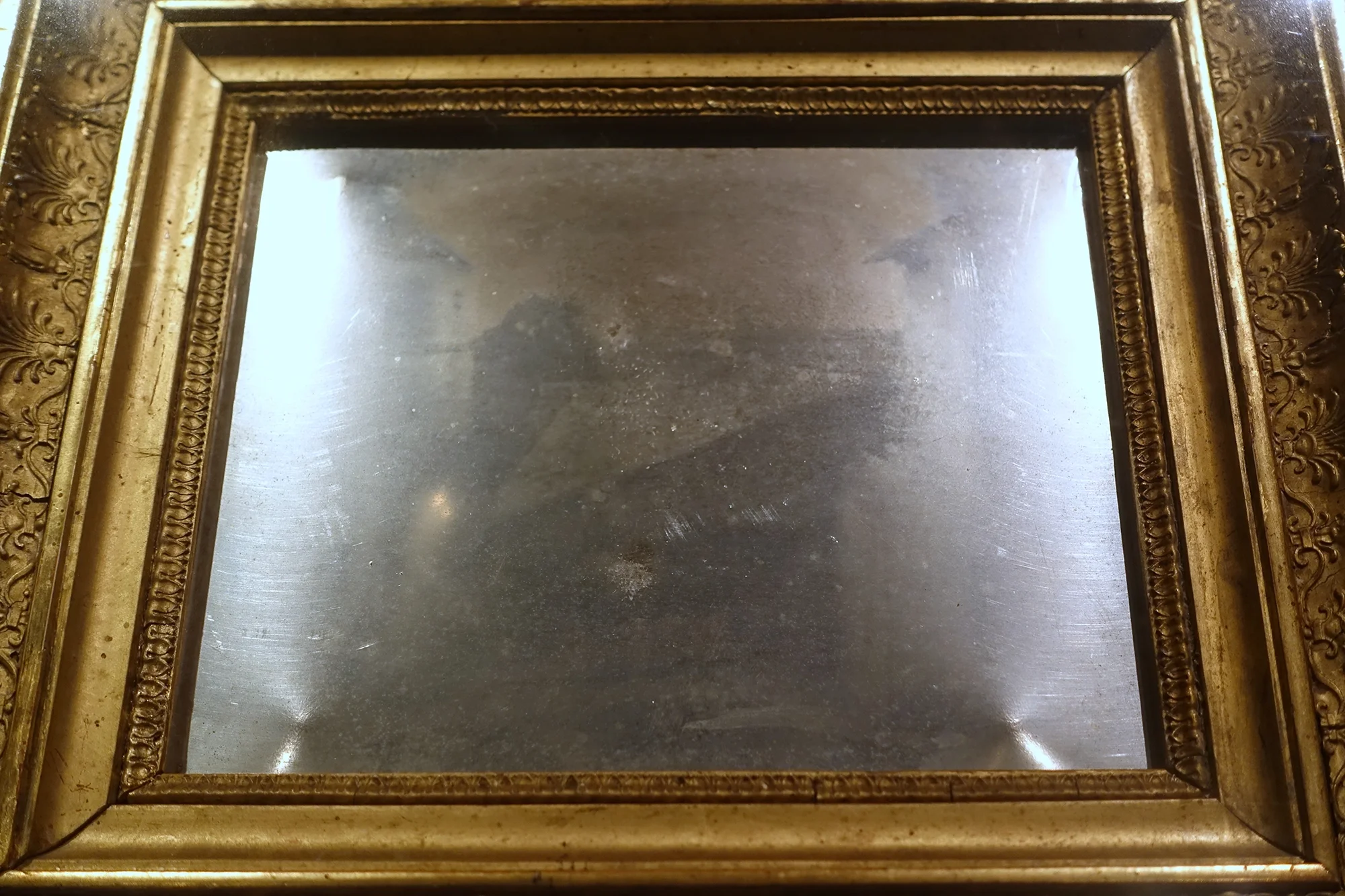
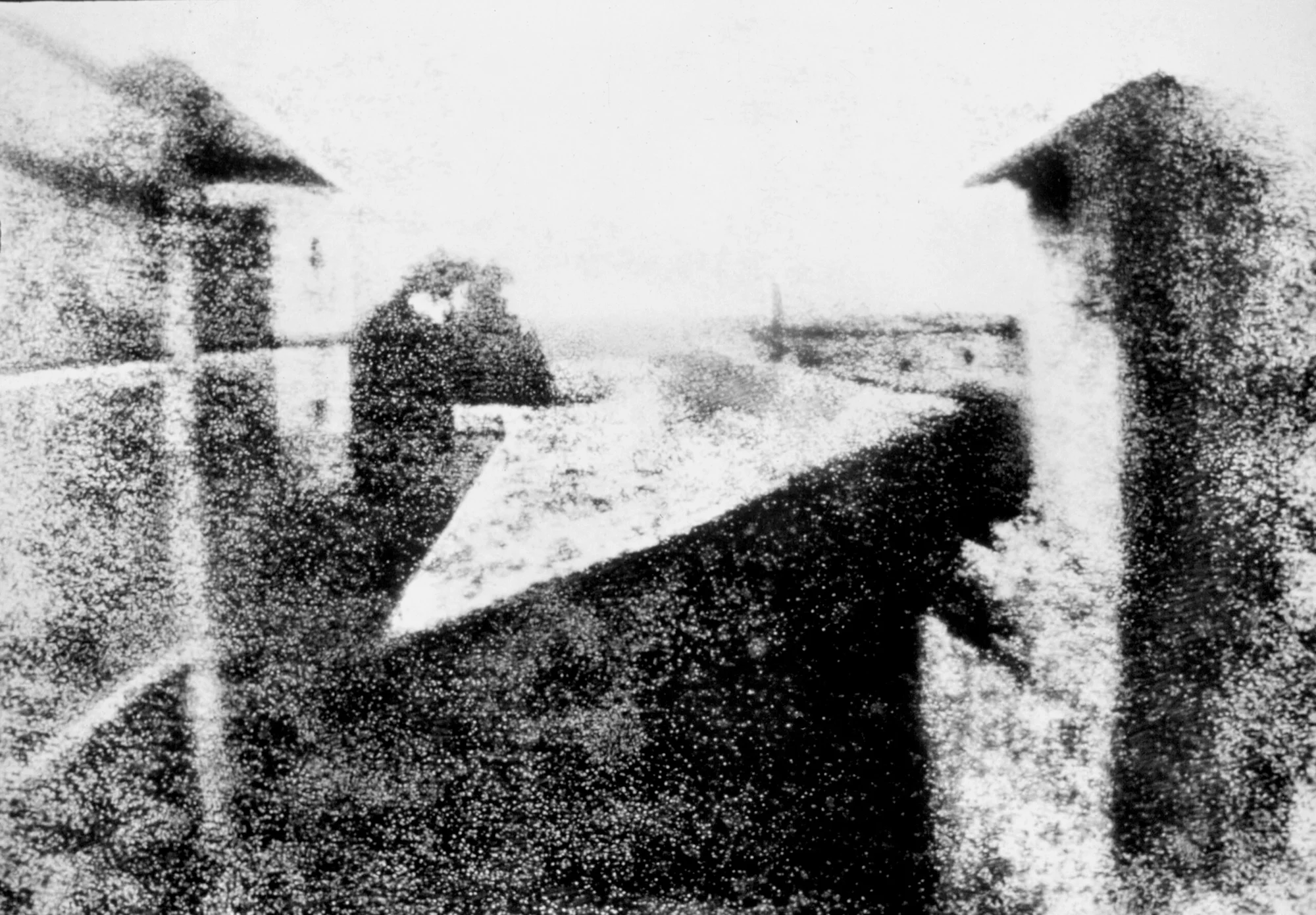
Image credit left: Photograph of the exhibit of View from the Window at Le Gras at the Harry Ransom Center, University of Texas at Austin, Austin, Texas, USA. Photograph by Daderot, Public domain, via Wikimedia Commons.
Image credit right: Nicéphore Niépce, Public domain, via Wikimedia Commons. Enhanced version by Helmut Gernsheim (1913–1995), created ca. 1952 from Niépce’s original plate held at the Harry Ransom Humanities Research Center, University of Texas at Austin. View from the Window at Le Gras, the first successful permanent photograph, created by Nicéphore Niépce in 1827 in Saint-Loup-de-Varennes, Saône-et-Loire, France. Medium: heliography (bitumen of Judea on pewter plate), approximately 20 × 25 cm. Due to the extremely long exposure (estimated about eight hours), the buildings are illuminated by sunlight from both the left and right.
Exploring the Influence of Establishing Photography as a Medium across Zero Baseline
Photography’s earliest milestones established its very possibility as a medium. These foundational firsts secured permanence, enabled reproduction, expanded into scientific observation, and entered the circulation of published knowledge. In doing so, they demonstrated that photography could move beyond isolated experiments. Together, they defined the framework for the medium to grow and endure—forever changing what we are able to see, and how seeing it shapes our thinking.
1827 JOSEPH NICÉPHORE NIÉPCE – FIRST PERMANENT PHOTOGRAPH
Produced the first stable image on a pewter plate, proving that light-sensitive chemistry could fix a visual record permanently.
1835 WILLIAM HENRY FOX TALBOT – FIRST NEGATIVE
Created the earliest surviving paper negative, introducing a process that allowed multiple prints from a single image and establishing photography as a reproducible system.
1837 LOUIS DAGUERRE – FIRST SURVIVING DAGUERREOTYPE
Produced Still Life in Studio, a positive, unique image of remarkable clarity that proved photography could capture and share the visible world with a fidelity beyond drawing.
1840 JOHN DRAPER – EARLIEST IMAGE OF THE MOON
Captured the Moon with a daguerreotype, extending photography beyond Earth and positioning it as a tool for astronomical research and scientific discovery.
1843 ANNA ATKINS – FIRST BOOK OF PHOTOGRAMS
Published Photographs of British Algae: Cyanotype Impressions, the first book illustrated with photographic images, demonstrating photography’s capacity for cataloguing and knowledge dissemination.