1990
Pale Blue Dot
Voyager 1, NASA
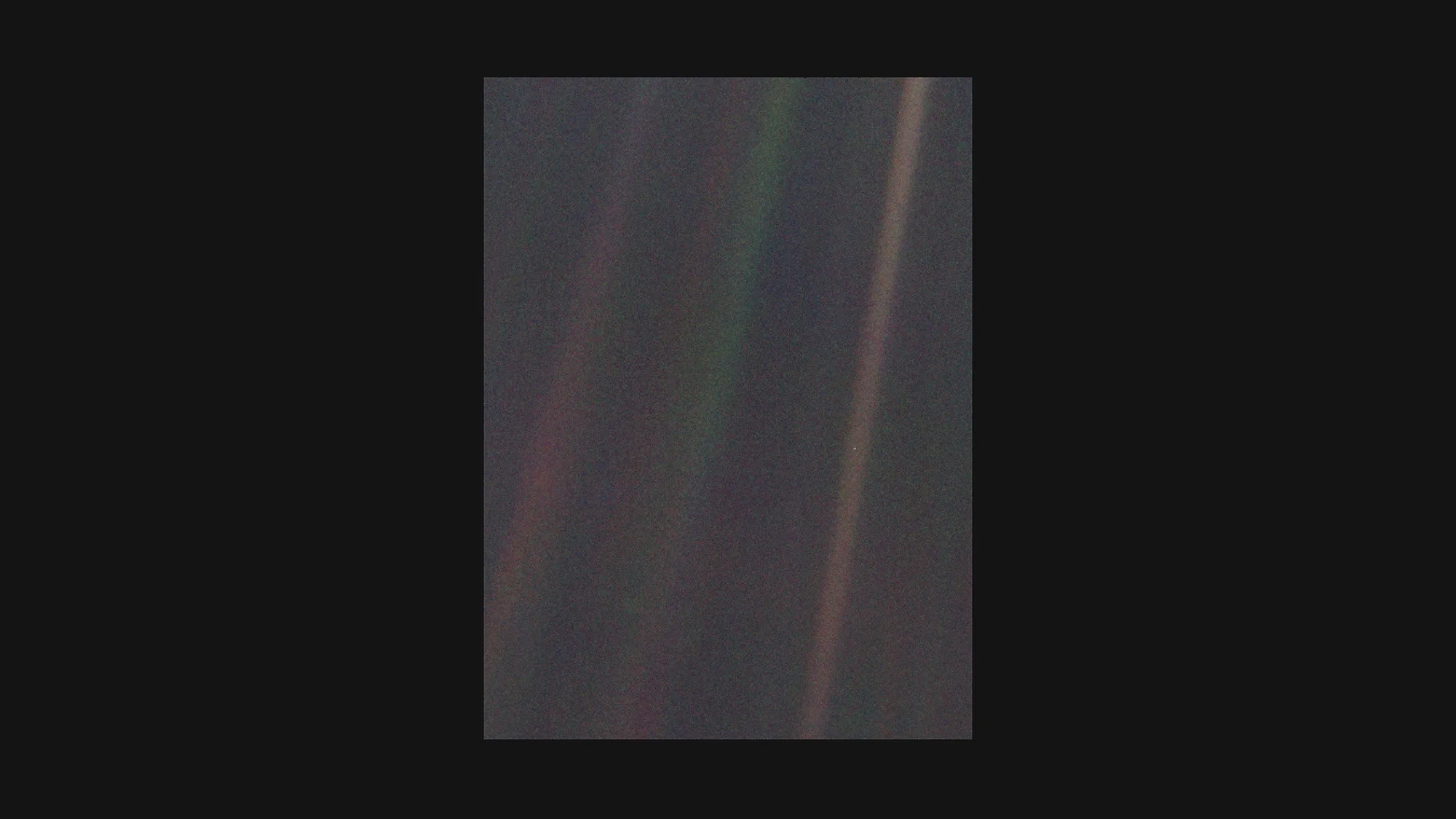
Narrow-angle imaging reveals our fragile planet in the vast expanse of space from 6 billion kilometers away.
In 1990, a moment occurred when the Voyager 1 spacecraft, billions of kilometers from Earth, turned its camera back toward home. Capturing our planet as a faint speck suspended in the vastness of space, this "Pale Blue Dot" image transcended its technical achievement to offer a profound visual revelation. Using narrow-angle imaging—focusing on a small portion of the field of view to capture finer details, even from incredible distances—Voyager 1 photographed Earth from about 6 billion kilometers away.
This defining moment not only contributed to our understanding of space but also marked a pivotal convergence of art and science. The image underscored photography’s unique ability to communicate scientific discovery in a way that words or numbers cannot. It established a new precedent for space exploration imagery, influencing future technologies used in both space missions and Earth observation.
The “Pale Blue Dot” reminds us of our planet’s fragility and the power of photographic techniques to evoke wonder and reflection.
KEY REFERENCE POINTS
TECHNICAL: Voyager 1 narrow-angle camera・6.4 billion km from Earth・0.12-pixel Earth crescent・60-frame solar system mosaic・violet/blue/green colour filters combined・original file 453×614px TIFF・scattered light artefact from near-solar angle
INFLUENCE: First photograph of Earth from outer solar system・part of first solar system portrait・direct precedent for pale blue dot tradition in space imaging・influenced Earth observation and deep-space photography conventions
ANALYTICAL: Narrow-angle imaging at extreme distance・colour composite from multi-filter capture・Earth indistinguishable from background noise・scale reveals planetary insignificance・artefacts from solar proximity document technical limits
CULTURAL IMPACT: Sagan's "Pale Blue Dot" address・planetary fragility as visual argument・art-science convergence landmark・reshaped public understanding of Earth's place in the cosmos・canonical image in environmental and existential discourse
ARCHIVAL RECORD
CREDIT: Voyager 1, NASA
AUTHOR: not specified
TITLE: Pale Blue Dot
DATE: June 6, 1990
ARCHIVE: NASA
SOURCE: Visible Earth NASA
ORIGINAL: 453 x 614. Tiff 682 KB
AVAILABLE INFORMATION: This narrow-angle colour image of the Earth, dubbed ‘Pale Blue Dot’, is a part of the first ever ‘portrait’ of the solar system taken by Voyager 1. The spacecraft acquired a total of 60 frames for a mosaic of the solar system from a distance of more than 4 billion miles from Earth and about 32 degrees above the ecliptic. From Voyager's great distance Earth is a mere point of light, less than the size of a picture element even in the narrow-angle camera. Earth was a crescent only 0.12 pixel in size. Coincidentally, Earth lies right in the center of one of the scattered light rays resulting from taking the image so close to the sun. This blown-up image of the Earth was taken through three colour filters – violet, blue and green – and recombined to produce the colour image. The background features in the image are artifacts resulting from the magnification.
EXTENDED CONTEXT
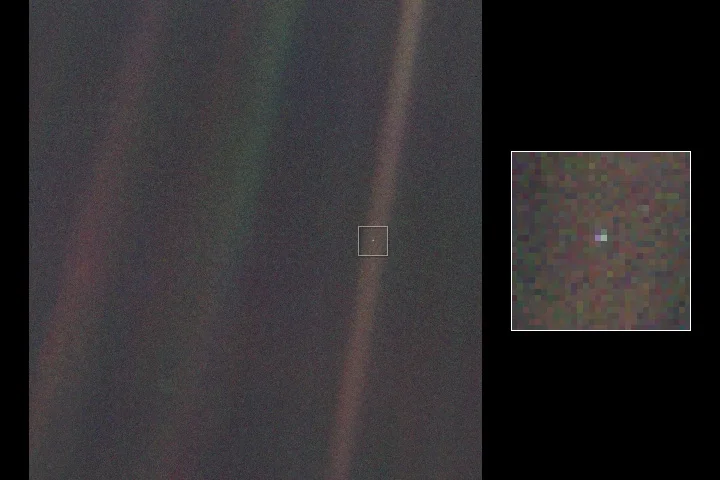
Image Credit: Earth from the edge of the solar system. 1990 NASA / Voyager 1.
Exploring the Influence of Camera in Motion across Zero Baseline
Placing the camera on a moving platform—whether mechanical, animal, or environmental—transforms both perspective and possibility. From early aerial surveys and pigeon-mounted cameras to systems carried on vehicles, vessels, or spacecraft, each method redefines the relationship between subject and vantage point. Motion can be intentional—tracking a subject in real time—or incidental, shaped by the path of the carrier itself. Techniques such as gyro-stabilisation, vibration isolation, and remote triggering ensure clarity despite continuous movement. By combining stability with adaptive navigation, camera-in-motion photography expands the scope of what can be recorded, offering views and contexts inaccessible from a fixed position.
1908 JULIUS NEUBRONNER – AERIAL PHOTOGRAPH FROM A HOMING PIGEON
Produced bird’s-eye views with miniature cameras strapped to homing pigeons, pioneering aerial perspectives from a living platform.
1968 WILLIAM A. ANDERS – EARTHRISE
Captured humanity’s first view of Earth rising above the lunar horizon, a perspective only possible from orbit around another world.
1990 PALE BLUE DOT
Recorded by Voyager 1 from the edge of the Solar System, showing Earth as a distant speck and redefining our cosmic perspective.
1995 ROBERT WILLIAMS AND THE HUBBLE DEEP FIELD
Directed the Earth-orbiting Hubble Space Telescope toward a seemingly empty patch of sky, revealing thousands of distant galaxies and expanding the observable universe.
2018 FIRST PHOTO INSIDE SUN CORONA
Returned the first images taken from the Parker Solar Probe within the Sun’s corona, capturing its outer atmosphere from a probe in close solar orbit.
2022 JAMES WEBB TELESCOPE - COSMIC CLIFFS
Used infrared imaging to reveal intricate star-forming regions in the Carina Nebula, opening a new era of space-based observation.