1851
Solar Eclipse
Julius Berkowski
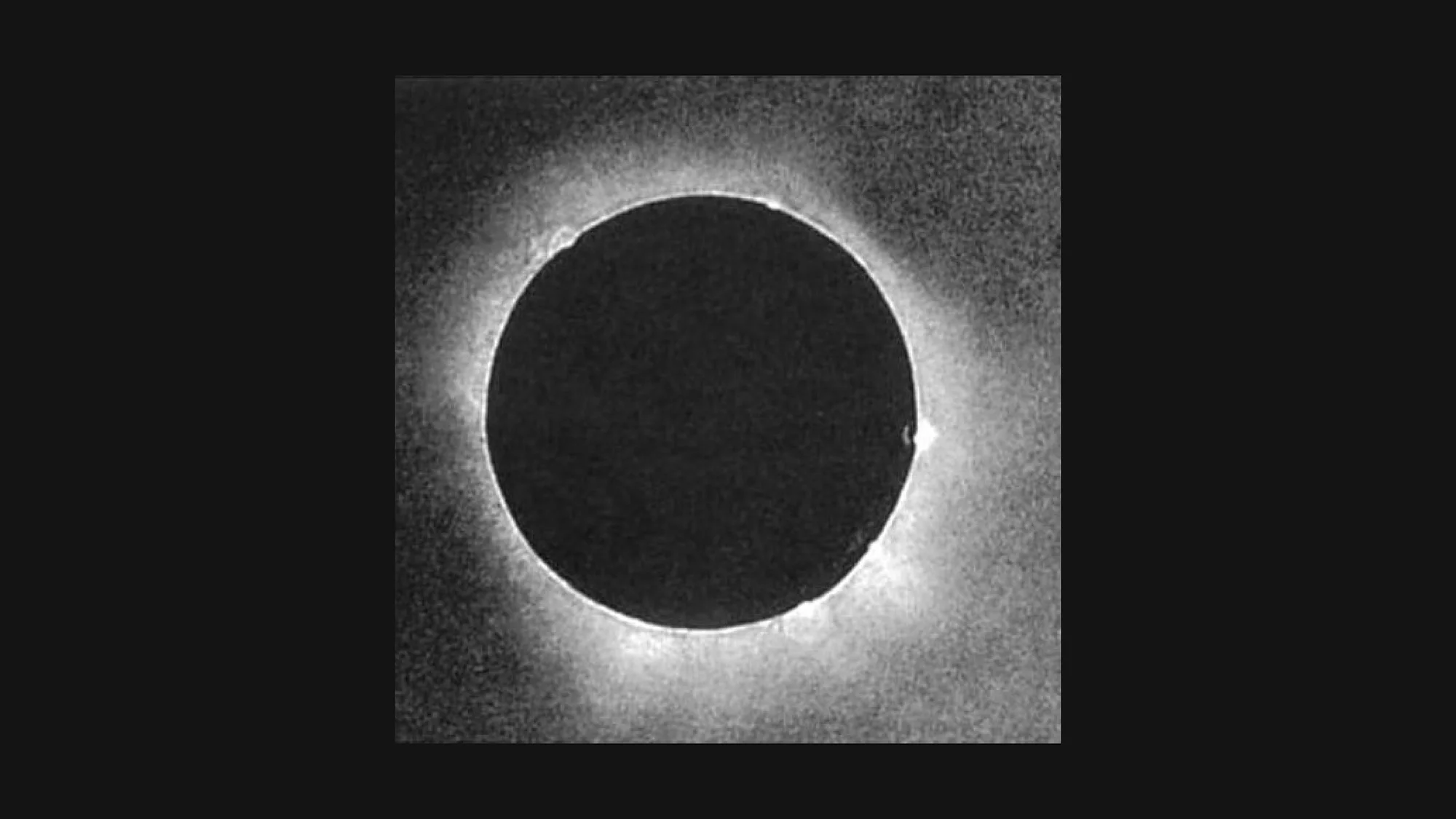
In 1851, Berkowski captured the eclipse, revealing unprecedented details of the solar corona and marking a milestone in photographic innovation.
Capturing the solar eclipse, Julius Berkowski’s photograph became a cornerstone in the evolution of astronomical photography. This groundbreaking image, utilising the daguerreotype process, was the first to record a celestial event with such precise clarity. Berkowski’s photograph unveiled the solar corona with unprecedented detail for the first time.
During an eclipse, the moon masks the sun's overwhelming brightness, revealing the faint corona. Traditionally elusive to the naked eye due to its dimness against the sun's brilliance, the corona's intricate structure was finally preserved in Berkowski’s image. The camera, meticulously linked to a heliometer for enhanced precision, allowed for extraordinary control over exposure and focus.
This photograph did not merely document an astronomical phenomenon; it demonstrated photography's dual role in art and science, reinforcing photography’s ability to capture and reveal the unseen.
KEY REFERENCE POINTS
TECHNICAL: Daguerreotype process・499×474px original・51KB JPEG・heliometer-linked camera・Royal Observatory Königsberg・28 July 1851・precise exposure/focus control
INFLUENCE: First known solar eclipse photograph・pioneered astronomical photography・demonstrated camera as scientific instrument・milestone in celestial documentation
ANALYTICAL: Solar corona visibility during totality・moon masking solar brightness・corona structure preservation・photography as observational tool・art/science dual function
CULTURAL IMPACT: Photography enters astronomy・unseen made visible・foundation for astrophotography genre・public domain heritage via Wikimedia Commons
ARCHIVAL RECORD
CREDIT: Johann Julius Friedrich Berkowski, Public domain, via Wikimedia Commons
AUTHOR: Johann Julius Friedrich Berkowski
TITLE: Unknown
DATE: 28 July 1851
ARCHIVE: Unknown
SOURCE: Wikimedia Commons
ORIGINAL: 499 × 474 pixels, file size: 51 KB, MIME type: image/jpeg
AVAILABLE INFORMATION: Daguerrotype. First known solar eclipse photograph taken at the Royal Observatory in Königsberg.
EXTENDED CONTEXT
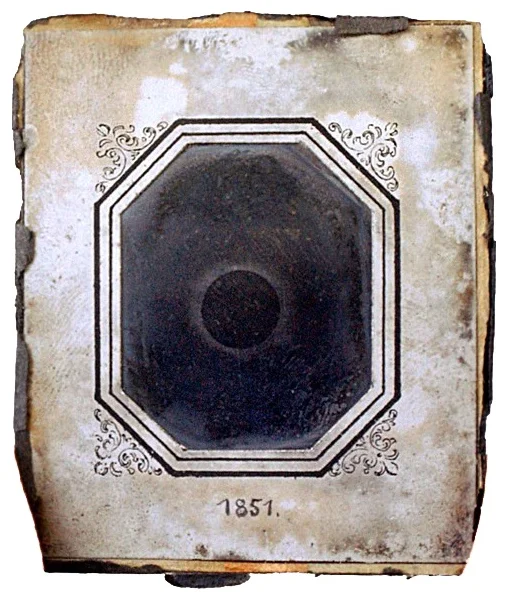
Image credit: Johann Julius Friedrich Berkowski, Public domain, via Wikimedia Commons
Exploring the Influence of Photographing the Sun across Zero Baseline
Photographing the Sun demands a balance of extreme light control and optical precision. From the first daguerreotypes to today’s ground- and space-based observatories, each advance has refined the ability to capture its structure without overwhelming the medium. Innovations in filtration, exposure timing, and high-resolution optics have revealed layers of solar activity once beyond human reach. These images are more than records of light—they are visual datasets, enabling the study of cycles, flares, and atmospheric dynamics that shape our planet’s environment. The pursuit continues to push imaging technology toward greater clarity and resilience under the most intense illumination.
1845 HIPPOLYTE FIZEAU AND LÉON FOUCAULT – FIRST SUN PHOTO
The first daguerreotype of the Sun’s surface, marking the beginning of solar photography and opening new possibilities for celestial observation.
1851 JULIUS BERKOWSKI – SOLAR ECLIPSE
The first correctly exposed daguerreotype of the solar corona, revealing the Sun’s outer atmosphere during total eclipse.
1874 TRANSIT OF VENUS
Photographs of the transit refined astronomical measurements and demonstrated photography’s growing value for scientific observation.
2018 FIRST PHOTO INSIDE SUN CORONA
NASA’s Parker Solar Probe returned the first images from within the Sun’s corona, offering unprecedented views of its outer atmosphere.
2020 REGINA VALKENBORGH - PERPETUITY LONGEST EXPOSURE
The longest exposure in photographic history traced 2,953 solar paths over eight years, transforming the passage of time into a single continuous image.