1898
Photographie sous-marine
Louis Boutan
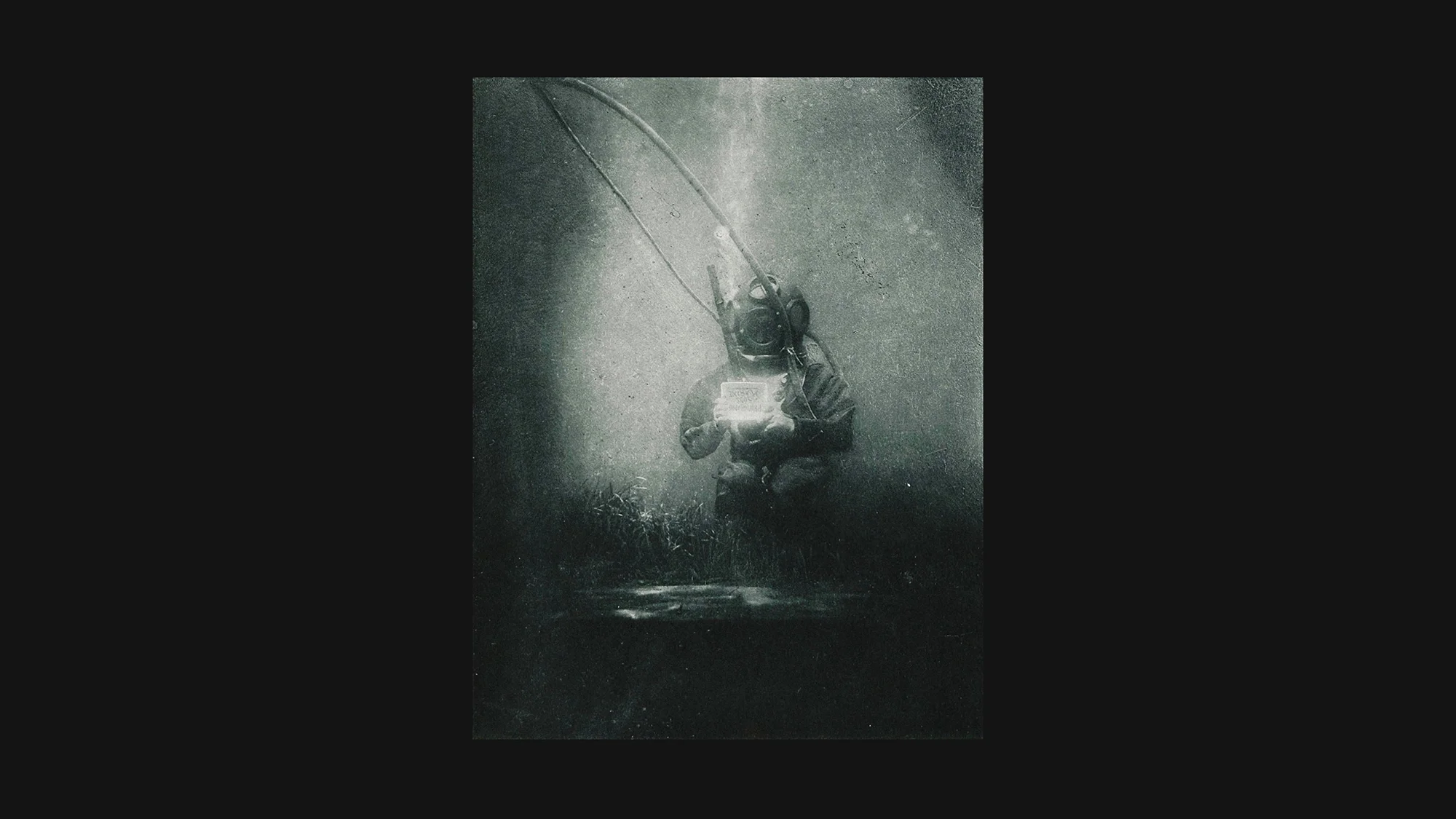
The first successful underwater photograph overcame technical barriers, giving rise to a new era of marine science and artistic discovery.
The journey to successful underwater photography began in 1856 with William Thompson’s early attempts, but it was Louis Boutan, a French biologist and photographer, who achieved the first true breakthrough. In 1893, Boutan developed a zero-pressure underwater camera with a frame size of 5×7 inches and exposure times of up to 30 minutes, overcoming the immense technical challenges of photographing beneath the surface. His most notable achievement came in 1898 when he used a magnesium powder flash system to capture the image of a diver, marking the first time both the camera and the photographer were submerged.
Boutan’s innovative approach transformed underwater photography, pushing the boundaries of what was possible both artistically and scientifically. His work culminated in the publication of the first book on underwater photography in 1899, and slides of his images were showcased at the 1900 Exposition Universelle in Paris, bringing this new visual realm to a global audience. By pioneering underwater photography, Boutan opened new avenues for exploration and laid the foundation for modern techniques in both marine biology and artistic expression.
KEY REFERENCE POINTS
TECHNICAL: Zero-pressure camera design・5×7 inch format・30-minute exposures・magnesium powder flash system・first fully submerged camera and photographer・helmet diving suit
INFLUENCE: First successful underwater photograph with submerged photographer (1898)・pioneering publication La Photographie Sous-Marine (1899)・1900 Paris Exposition Universelle exhibition・established underwater photography methodology・enabled marine biology visual documentation
ANALYTICAL: Solved pressure and light transmission challenges underwater・demonstrated feasibility of subsurface imaging・created visual access to previously invisible marine environments・established technical foundation for oceanographic research・proved viability of artificial illumination underwater
CULTURAL IMPACT: Revealed hidden underwater realm to public consciousness・bridged artistic and scientific documentation・expanded photographic possibility beyond terrestrial limits・inspired exploration aesthetics・transformed perception of ocean environments
ARCHIVAL RECORD
CREDIT: Louis Boutan, Public domain, via Wikimedia Commons
AUTHOR: Louis Boutan
TITLE: Photographie sous-marine (Underwater Photography)
Date: 1899 (published image)
ARCHIVE: Spiridon Manoliu's pictures
SOURCE: Source: Wikimedia Commons, Internet Archive
ORIGINAL: 1,652 × 2,142 pixels, file size: 708 KB, MIME type: image/jpeg
AVAILABLE INFORMATION: Emil Racovitza as diver at Observatoire océanologique de Banyuls-sur-Mer. The upside down sign the diver is holding says ‘Photographie sous-marine’ (underwater photography).
EXTENDED CONTEXT
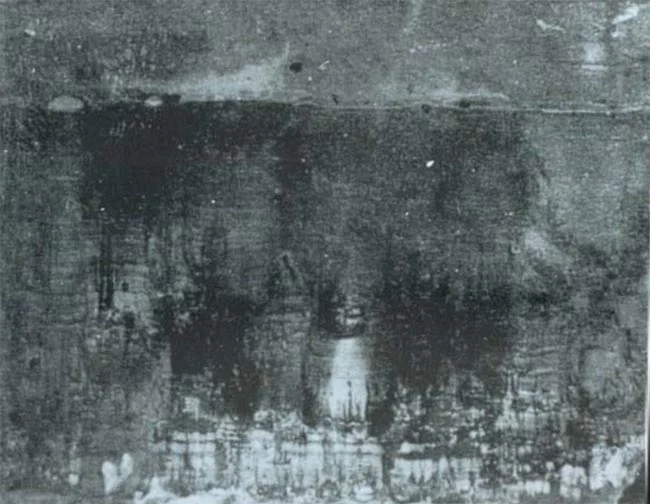
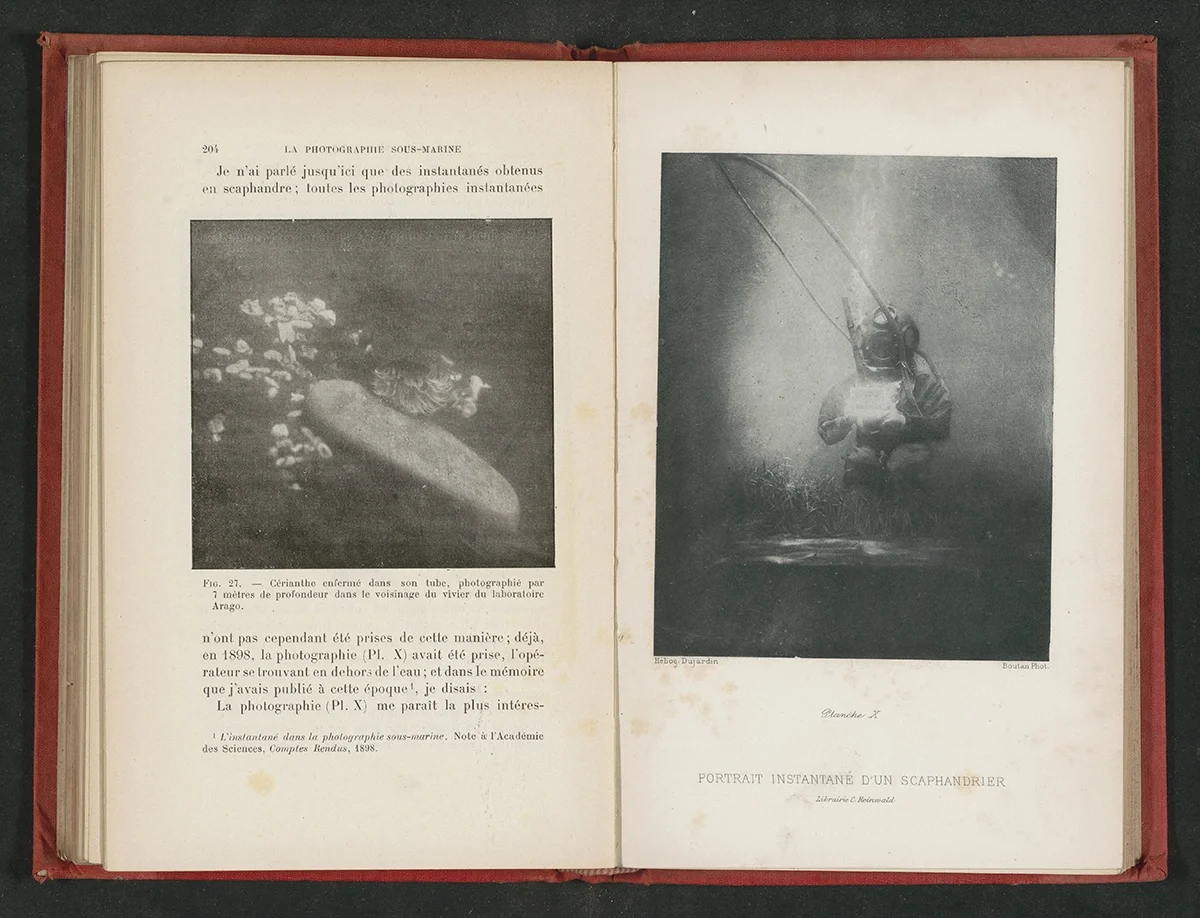
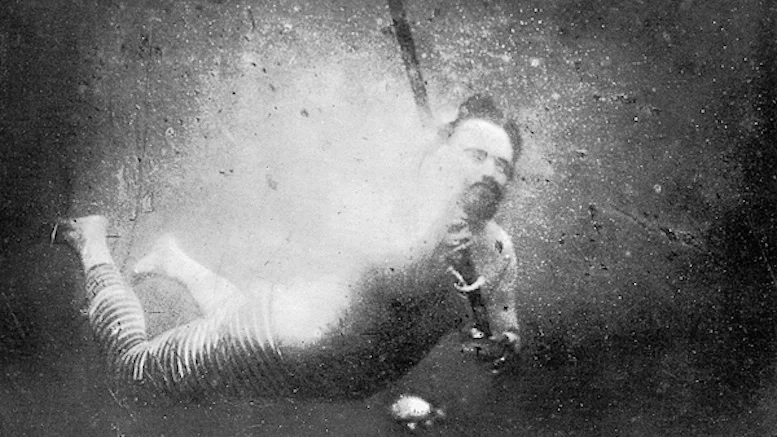
Additional credits (left to right): Image credit 1: 1856 William Thompson, First underwater photograph attempt using a wet colloidion glass plate camera. Image credit 2: Rijksmuseum, CC0, via Wikimedia Commons. Image credit 3: 1893 Louis Boutan, self-portrait (Public Domain). https://monovisions.com/louis-boutan-biography-19th-century-pioneer-of-underwater-photography/
Exploring the Influence of Self-Inclusion across Zero Baseline
Self-inclusion in photography places the creator within the frame, not as subject in the traditional sense, but as an active element of the process. In scientific and experimental contexts, this often takes the form of embodied observation—using one’s own presence as the constant in generating reliable, repeatable data. Whether for calibration, as a control in experimental conditions, or to merge observation with participation, it aligns the act of seeing with the act of being seen. This approach transforms the camera into both recorder and witness of the photographer’s presence, producing images where method and subject converge. Self-inclusion bridges the gap between observer and observed, embedding the maker’s role directly into the visual record.
1886 ÉTIENNE-JULES MAREY – SHAKING A FLEXIBLE ROD
Used his own body to generate repeatable motion patterns, embedding himself directly into the process of visual study.
1889 ÉTIENNE-JULES MAREY AND GEORGES DEMENŸ
Appeared as their own test subjects, integrating the observer into motion studies for calibration and consistency.
1895 RÖNTGEN – FIRST X-RAY
Exposed his wife’s hand to produce the first X-ray image, making a groundbreaking scientific record through a personal and embodied act.
1898 LOUIS BOUTAN - FIRST UNDERWATER PHOTOGRAPH
Entered the aquatic environment with experimental equipment, embedding himself in the process to test and refine submersible photography.
1935 MAN RAY – SPACE WRITING (SELF-PORTRAIT)
Performed gestures with light during long exposure, transforming self-inclusion into a performative, photographic self-portrait.
2023 CHELSI ALISE COCKING AND JIMMY DAY – ILLUMINATE
Rendered human motion as luminous trails in real time, enacting self-inclusion through gesture and transforming movement into a continuous photographic record.